A blog by Brian Carson
Background
In my last blog I mentioned having an enforced break from physical activity while recovering from a hernia operation. As expected this was a difficult period for me personally and probably for those around me as they had to put up with my grumpiness about not being able to exercise. However by planning things to do other than exercise and having a positive attitude about my eventual return to activity, I managed to get through the down time with no real issues. It also helped that my down time was across the Christmas and New Year period when a lot of the organised activities I am involved in were unavailable during the holiday period. I certainly coped much better than I would have 3 months earlier when I was not managing my Parkinson’s so well, and struggling with my motivation to keep active.
My Route to Fitness
When I left hospital on 9th December following the operation I was advised to be as mobile as possible but take no exercise for 4 weeks and not lift anything heavier than 2kg during this period.
Within 2 days I was out walking but felt this was too risky because of the cold weather and ice. A fall could cause considerable damage so soon after surgery, therefore an alternative was needed.
Plan B was using a treadmill. I started daily (almost) 3k walks in the warmth and comfort of home. This kept me ticking over and feeling more positive about my recovery and the route back to the fitness levels I had before the surgery. Not to mention helping with the weight loss needed to get back to where I was previously.
Ten days after the op I went along to the weekly Parkinson’s Table Tennis session at Drumchapel Table Tennis Club. This was the last session of the year and we had a lunch party planned after the session. It was difficult to watch the session and not play and I eventually picked up a bat and hit a few balls, but just from a stationary position. From this point onwards I was itching to get back to playing TT.
I wasn’t as active as I should have been in the days immediately before and after Christmas (probably the same as most people). However, a few days after Christmas I attended a regular non Parkinson’s session at Drumchapel. I was sensible enough to hold back a bit in this session but it felt great to get back on the table and I had no issues during and after the session.
I continued to attend any available TT sessions over the next week and progressively increased my movement and effort at each one.
Four weeks after the surgery the doctor conducted a planned review and gave the go ahead to get back to my full activity routine. I didn’t share with him that I was probably up to around 50% of my previous routine activity by that time. Ahead of schedule but I had managed this carefully with minimal risk.
Next Steps
Fortunately this go ahead was given the week when all activity sessions got back to normal post the Christmas break. Now that I was officially “off the leash” there was no stopping me. That week I played table tennis (4 sessions)🏓, attended a PD exercise class🏋️♀️, and a Pilates class 🧘♀️, played walking football ⚽️, and even had a session on the driving range 🏌🏻where almost every ball was straight and long, although that will not last 😂.
I enjoyed every minute of every session but did get tired quickly sometimes, due to my lack of fitness. I appreciated that fitness would improve in time but being a bit impatient I decided to condense some activity over a week to help things along.
I opted to spend a week abroad in the sun at the end of January, cycling, running and walking, and enjoying the added bonus of some winter sun.
I set myself a daily schedule of cycling in the morning and running or walking in the afternoon. I managed to keep to this although by the end of the week I replaced the running with longer walks due to some knee pain. This sounds intensive but in reality I had time to have a leisurely lunch and catch up on some reading each day between sessions.
Exercising everyday is a challenge as there is not much recovery and rest time if there are zero days off. However over such a short time this was manageable and I had a few days down time for rest on my return home before getting back into my activity routine.
There was a downside as I was not able to play table tennis while I was away, (couldn’t find a table anywhere) and beer consumption for the week was probably a bit much from an exercise perspective.
However taking the big picture view, I had a great week in the sun, got some exercise and had some fun, and am confident that I am much fitter than I was the week before.
I have also had some great thinking time to consider what I do next. This included my activity routines, what table tennis events I want to play in this year, and what Parkinson’s activities I would like to be involved in. I will hopefully have more to say on this in a few weeks.
Activity and Parkinson’s
My friend and fellow PWP and TT player Steve Morley, recently published a blog titled “Why do you Train?”. This describes some discussions he has had on what motivates PWP to participate in physical activity. See quote below:
If the answer to the question Why do you Train is “to beat PD” then sooner or later I believe you will fail. You need a better reason to train: to run a faster 5km, to cycle 100km, to do an open water swim, whatever gets you excited. Then you will feel motivated to train despite PD, not because of PD.”
I agree with the first part of this statement in that we can’t beat PD as there is no cure, and if that is a motivation for activity then you have failed before you start.
However on the second part of the statement my view differs very slightly. My motivation is not to achieve faster times, longer distances etc, I see these as a by product of the activity. Yes if I am playing table tennis or football etc I am competitive and play to win, but that is not why I exercise.
My personal motivation to exercise is to have a level of fitness and movement that will allow me to “manage” my Parkinson’s for as long as possible on my terms, maintaining my quality of life. To do this I participate in activities that provide benefit, that I enjoy and have fun doing, and yes sometimes I do push the boundaries to improve. Remember, it’s not just physical benefit we get from these activities, but also mental and social benefit, which are also very important, but that is a discussion for another time.
I am not ignoring medication. I view medication and activity both as vital contributors in helping me manage my condition.
Awareness of Parkinson’s
I get a lot of encouragement and feedback to my blogs and posts about my motivation for what I do. Sometimes words and phrases are used that while are encouraging and supportive, make me realise that there is much more to do in raising awareness in the non Parkinson’s community of what this degenerative disease involves.
Most people outside the Parkinson’s Community have a view of what Parkinson’s looks like but don’t understand the complexity of the condition. For a lot of people the belief is that if you have Parkinson’s you will have some form of tremor, possibly stoop a bit, and be a bit slow walking and moving.
There are more than forty symptoms and as mentioned previously PWP have different combinations of some of these symptoms. It is important to realise that a lot of these symptoms are non motor and are therefore not visible. See my previous blog on Depression, Anxiety and Apathy, to name but a few.
Despite this it is possible to live well with this condition and many people do.
The illustration below is the perception some people have of Parkinson’s.
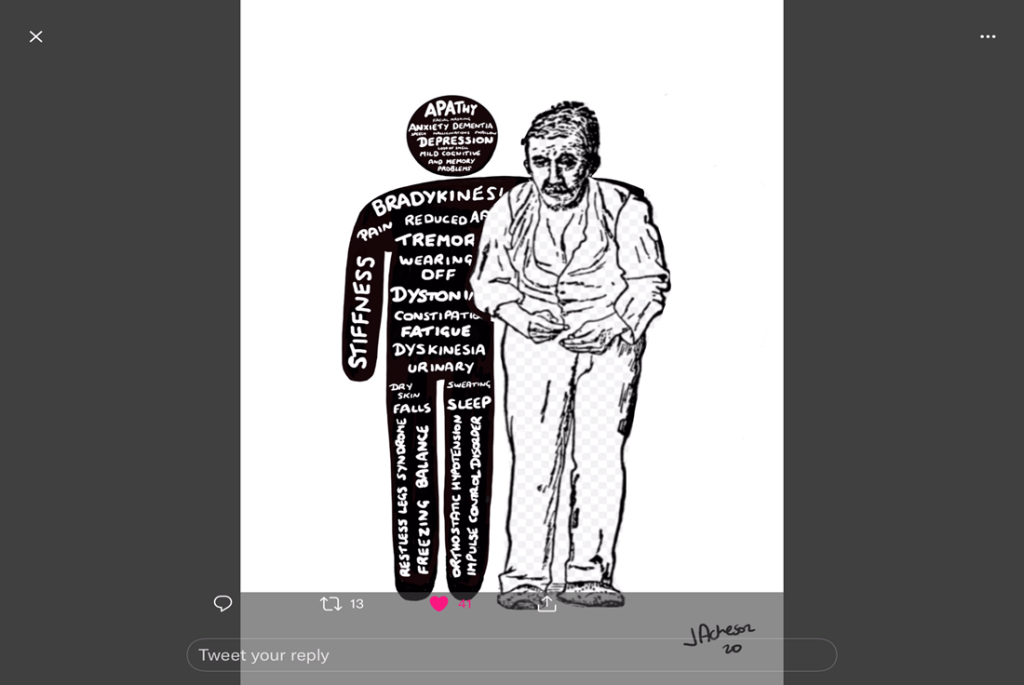
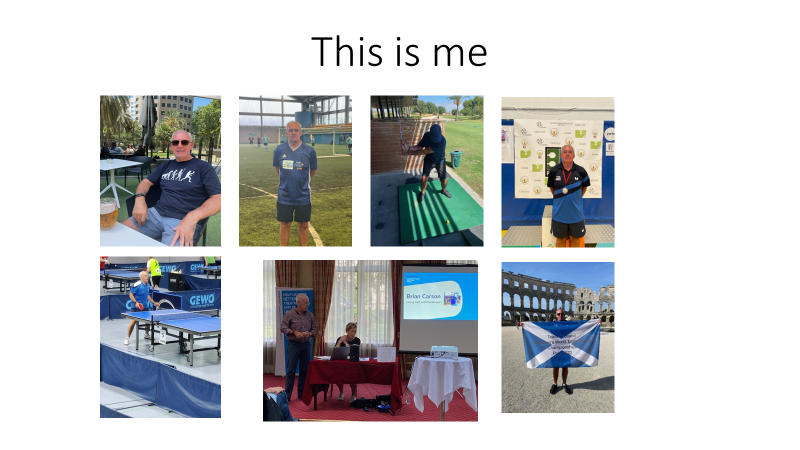
This is not me!
Note: Saying “we can’t beat PD” while true sounds very defeatist. I have stated in other forums that having Parkinson’s is not life ending, but is life changing. My personal view is that with the proper support and advice it is manageable for most people and that is what we strive to do.
Hopefully that message is what most readers will take from this blog.
End


 Batman Brian
Leave a reply to Drew Wilson Cancel reply