-
Stockholm Veterans Open

A blog by Brian Carson
11 May 2023
All views in this blog are my own.
My Parkinson’s Table Tennis Adventure continues (Part 1)
I have had a very busy few months where I have taken on some new Parkinson’s responsibilities in addition to my usual physical activity, local volunteering, and playing sport. This has been very rewarding, interesting and challenging and I am grateful for the opportunities I have been given to contribute.
Recent Activities
I have also been involved in setting up the Scottish Parkinson’s International Table Tennis Open which takes place in August and I will cover this in later blogs.
However, table tennis is my focus for the next couple of weeks and it has been too long since I bored everyone with a blog.
After a week at home following the brilliantly organised and executed Eystrup competition it is great to be back on the road again heading for the Veterans event in Stockholm.
Eystrup
I can never overstate the great experience we had in Eystrup and again I say thanks to Lars Rokitta for his commitment and passion which shone through at that event.

With Lars in Eystrup
Travel
I have written previously about my nervousness travelling with PD and this trip is no exception. I had a recent Facebook discussion about travel with some others who are living with PD and it turns out I am not alone in these feelings. However we all had the same attitude that while travel is not something we enjoy we will continue to do so while we physically are able, as the reasons for travel are not something we want to give up on yet. For me it’s holidays, table tennis events, sightseeing and spending time with friends. Hopefully I am a long way off from having to cease or even reduce these activities.
Today I am heading to Stockholm via Heathrow. A direct flight is easier to manage but recently the destinations involved have the complication of a flight change as direct options have not been possible.
Eystrup was a prime example where a change at Amsterdam was needed but this was made much easier as I met up with Cecilia and Torgny from Sweden in Schipol and we travelled on to Germany together. This proved to be fortunate on the return journey as Torgny was injured during the competition and travelled mostly in a wheelchair. We were able to help him get through Bremen and Schipol airports although I wonder what other passengers made of us as we three PWP shuffled around the airports, one of us in a wheelchair. But we made it by supporting each other and had a few laughs along the way. Torgny definitely should have had Learner plates on his wheelchair.😂
Sweden
So I am en route to Stockholm to play in the second Veterans Open which for the first time has a Parkinson’s classification event included. I am grateful to Pelle Hanglund (aka Py Tagaros) for the invite and for facilitating my registration.
The competition is being held in Tammsvik which is an hours drive north west of Stockholm and we will move to the area on Friday evening for two days of play Saturday and Sunday. All players are staying at a conference hotel near the venue and we have a dinner planned for Saturday night as as a group.

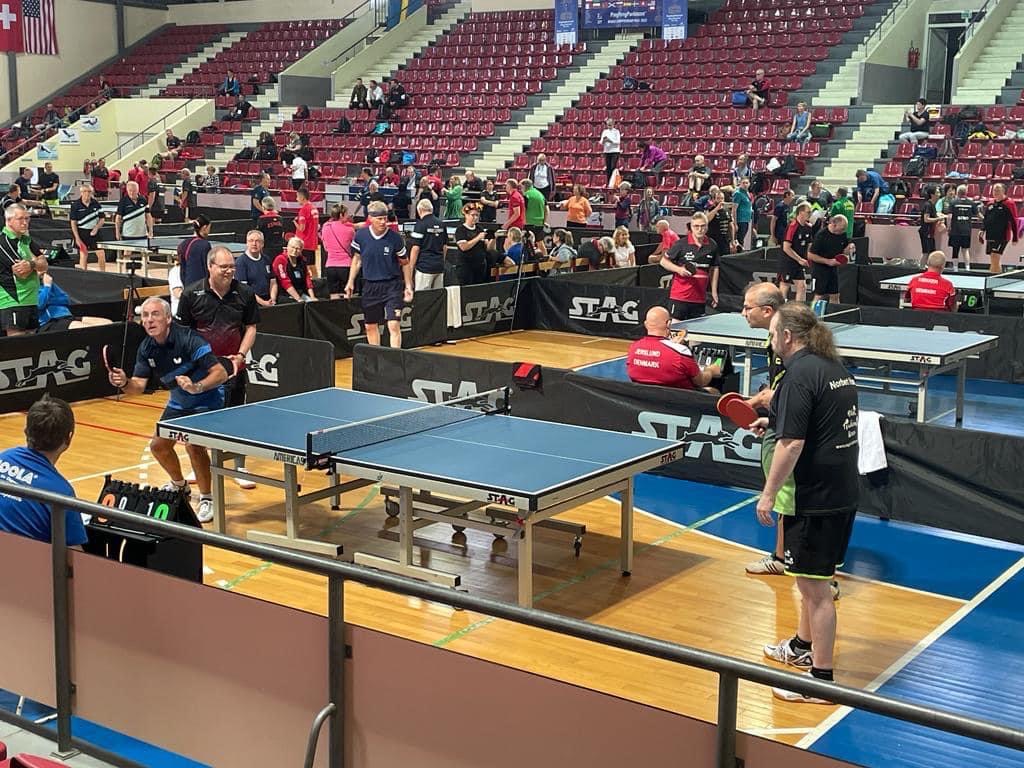
The Venue
We have players from Sweden 🇸🇪 Germany 🇩🇪 Portugal 🇵🇹 Norway 🇳🇴 USA 🇺🇸 and Scotland 🏴, and I will say Finland 🇫🇮 (Seppo – Swedish or Finnish? 😂)

My potential singles opponents.
I am playing Parkinson’s singles and doubles and a banded singles for all players ( Vets and Parkinsons)On Friday we are playing a mixed doubles event at the Sparvagens BTK Table Tennis club in Stockholm where Pelle coaches a weekly Parkinson’s group.
My preparation has not been ideal as I have been resting for a week with a knee injury but that won’t affect the enjoyment I will get from playing and socialising with these fantastic people.
Readers of previous blogs will know, but I will say it anyway, the benefits of this type of activity for PWP are not only physical, there are also social and mental benefits from the non playing activities not to mention the peer support we provide for each other.
What Next
I will remain in Stockholm for a few days after the competition for some sightseeing and socialising.
I will post competition updates on Facebook over the weekend, and next week write a summary of my experiences before I start Part 2 of this adventure. 🏓💪
End
-
Parkinson’s Portuguese Open Table Tennis Championships (1 to 3 July 2022)

A Blog by Brian Carson
5 July 2022
This event took place in Cascais in Portugal.
The short blog details my experience at this event, what I, and I think all of the People with Parkinson’s (PWP) playing, got from the competition and what we expect to do next. I have used a lot of photographs in this blog as I think they describe the experience far better than my words. Apologies to those who are not in any of the photographs, there were just too many to include them all.
The competition was the brainchild of Damásio Caeiro and he has been dreaming of holding the first Portuguese Open since he attended the first Parkinson’s Table Tennis World Championship competition in New York in 2019.
Taking on this responsibility was a major undertaking and at times the strain has shown on Damásio as he dealt with issues and problems up to and during the event.

Damásio Caeiro (He’s the Man) Some things went wrong some things were very good and some things were in between these two extremes. I am not going to dwell on these things in this blog as we who attended understand the challenge in holding this event, and Damásio has already starting working on what can be improved to make this event even better in 2023. I hope he gets some good support to arrange the next event as we want to see Damásio enjoying the experience with us, playing table tennis to the high level we all know he is capable of, and not in the role of planning and administering, as this is not his strength. He is a writer and a poet, not a project manager, although what he may lack in project management experience he certainly makes up for in his passion and commitment to this event, his TT Club, his home town, and the wider Parkinson’s Table Tennis Community.

The Venue The Location
Cascais proved to be a beautiful part of Portugal and lived up to everything Damásio said it would be. On finals day we had a later start as a sightseeing tour was arranged for a couple of hours to let us experience the full beauty of the area. We visited Devils Mouth – Boca do Inferno and drove along the Estrada Do Guincho to the Praia Pequena do Guincho. Which were areas of natural beauty and breathtaking to see.

The view at Praia Pequena do Guincho We were located in three hotels around the area and travelled by coach each day to the competition. But this was not the only time we seen each other as a group. We came together in one of the hotels most nights to socialise and continue developing our friendship, despite some language difficulties these get togethers proved to be a key part of the experience.

Evening get togethers The Event
We had a short opening ceremony with a local music group leading the players into the arena to assemble together to hear an event opening speech, followed by a brief explanation of the competition rules. I was given the honour of leading the players in this procession as I was the first player to register for the competition. I was also the sole representative from Scotland.

Opening Ceremony 
Opening Ceremony Compared to other Parkinson’s TT competitions the number of players at the Portuguese Open was small. Approximately 40 players from 12 countries took part. This was smaller than hoped but taking account the number of competitions now taking place and the travel and expense involved to get to the host countries, this number is a success in my view. PWP are choosing what is best for them not only based on travel and expense but also the need to factor in the level of their Parkinson’s and how they manage their treatment regime, their family and home commitments, and in some cases their employment.

The Players and Volunteers We played TT for three days in this event. Three fantastic days where we won, we lost, we got tired, we got elated, maybe a little “off” when medication was not quite working, but the smiles and support and togetherness were always present.

Ladies together 
Every match played with a smile 
Liz and Pauline from England 
Some of the host team and volunteer 
Friends not opponents 
Maik being Maik 
Preparing for my next match 
Norbert winning everything 
Having fun This was a sporting event where the sport was secondary. The priority was being together as a community, sharing the common bond that we have through Parkinson’s, but more importantly being together, supporting each other, laughing together and crying together. I have never been one to show much emotion but as I attend each of these events I surprise myself every time by becoming more and more emotional as the depth of feeling I have for this community and this sport grows.

Lars and Damásio 
A visit to the podium I will never forget the emotion shown by Damásio as he spoke at the presentation ceremony about his competition not being everything that he hoped for, only to be told by the players, families and officials in one voice that he had delivered a great event.
Nor will forget how my great friend Lars Rokitta and I held each other and cried after the presentation ceremony as we realised what we had just been part of, what our friendship means and our commitment to help this community through table tennis and any other means available.

Emotions run high After the presentation ceremony concluded we were taken to a local club, the Groupe Musical e Desportivo 31 de Janeiro de Manique de Baixo. Here we had a meal prepared by our hosts of local Sardines and meats served with lots of wine and accompanied by music and dancing. A great conclusion to the event.
What Next?
We now all return home to our “normal” lives, managing our Parkinson’s as best we can, play table tennis, and spread the word about exercise and in particular table tennis, and what it can mean for PWP. As I write I am travelling home from Portugal and this very evening we have a webinar taking place where Table Tennis England, supported by the Parkinson’s UK Scotland Parkinson’s Active team are encouraging TT coaches around the UK to become involved in bringing table tennis to more PWP.
For most of the players who attended this event the next focus is the Parkinson’s World Table Tennis Championships taking place in Pula in Croatia in October. For those in the UK we have the small matter of the UK Parkinson’s Table Tennis Championship’s taking place at Drumchapel in Glasgow on 7th August. This is only the second time this event has been held, the first time in Scotland and we at Parkinson’s Table Tennis Scotland are very proud to be hosting this competition. It is fully subscribed with all player slots taken. This will be another opportunity to come together as a community and further the cause of TT for PWP while having fun. I look forward to catching up with many friends at this event.
Parkinson’s Symptoms and Treatment.
I would normally include some information in these blogs on some of the 40 plus Parkinson’s symptoms, treatment and management of these and the benefits of exercise. I have excluded these for this blog only as I do not want to detract from trying to describe the fantastic experience at this competition. Normal service will resume in my next blog.
End
Brian Carson
-
Living with Parkinson’s, 2024 My Year so Far
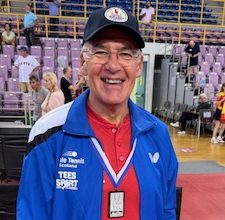
A blog by Brian Carson 3 April 2024
All opinions are my own.
This is my first blog of 2024. I can’t believe we are in April already which means that 25% of the year has passed. Where did it go? Previously I have mostly blogged about individual events. However, this year I thought I would try something different and blog at regular (or semi regular) intervals to provide a flavour of what life is like as I live with my Parkinson’s. How I am coping, or not coping, and what I activities and events I am involved with in the Parkinson’s community, and some of the challenges involved.
JANUARY
A new Year!
After the Christmas holiday period I am always keen to get back into my routine. The holiday break was enjoyable but the downside to this time of year for me is the 2 to 3 week period when all the physical activity sessions I take part in are closed. This is not a complaint but a recognition of a period where myself and many other PWP are at the mercy of our own discipline and motivation with respect to maintaining the physical activity that is vital in keeping us active and moving. It is fair to say that I have mixed results during this period, sometimes the motivation to exercise is strong and sometimes a comfy sofa watching tv eating chocolate is the winner.
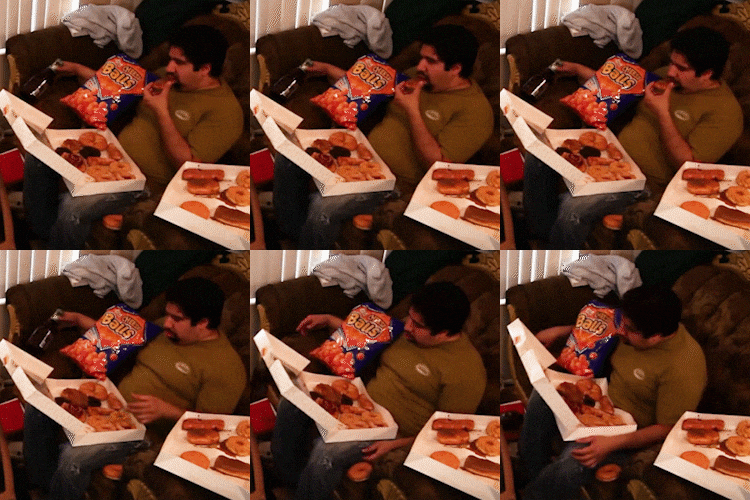
A day of weak motivation. 
What my weekly schedule looks like, for activities only. I don’t attend every but get to as many as possible.
Back into Routine
On the second week in January it was back into routine and I was my usual happy self. During this week we celebrated the two year anniversary of the Parkinson’s TT session beginning at Drumchapel and I supported a new Parkinson’s TT session at Dunlop TT Club funded by a Parkinson’s UK Physical Activity Grant.

The inaugural Dunlop Parkinson’s TT session, attended by Provost Jim Todd
Also in January I was pleased to be featured in a Parkinson’s Faces Project which featured black and white photographs of PWP. This project was the creation of Nikolas Koukoulakis, who I met at the ITTF Parkinson’s championships in Crete last November.

FEBRUARY
Trustee Responsibilities
In each of the first two weeks of February I spent two days at the Parkinson’s UK Head Office in London. The first week I was supporting interviews for new staff recruitment and in the second week I was attending a regular Trustee Board review. This made for a very busy, and tiring two weeks and meant I had to forgo some of my regular activity sessions. Unfortunately I also missed the first Glasgow Parkinson’s Support Group monthly meeting of 2024. However I feel very privileged to be the Scottish Trustee for this charity and take this responsibility very seriously.
Stockholm Veteran Open
Immediate after the second trip to PUK Head Office I travelled directly from London to Sweden for a Table Tennis competition. I have previously mentioned my nervousness when travelling, particularly when alone. The first part of this trip in London took this to a whole new level. I had given myself the challenge of getting from central London to Stanstead Airport by underground and by train, with luggage, during the morning rush hour. Not an experience I would like to repeat any time soon. I will spare the details but trying to manoeuvre luggage on escalators and elevators at my pace, with hundreds of people trying to get past me and then packed so tight in a tube train that I could hardly move made it difficult to maintain my happy demeanour, not that anyone in my vicinity was interested. We live and learn.
I arrived safely in Gothenberg and caught up with friends and the following day we travelled to Vasteras near Stockholm for the two day weekend event. The competition was a veteran event with a Parkinson’s event running in parallel. The Parkinson’s player numbers were down on last year and as a result some categories of competition were combined.
On Saturday we were not due to play until midday and for some reason a few of us decided to walk the one mile distance to the arena in the sunshine as we were in no rush to get there. However the sunshine was deceiving and the roads and pavements were covered in ice! Torbjorn was the self appointed “sherpa” for this expedition and led myself, Cecilia, Torgny and Seppo through the treacherous streets. What a sight we must have been, 5 PWP trying trying to remain upright in the icy conditions. Thankfully we made it with no major incidents.
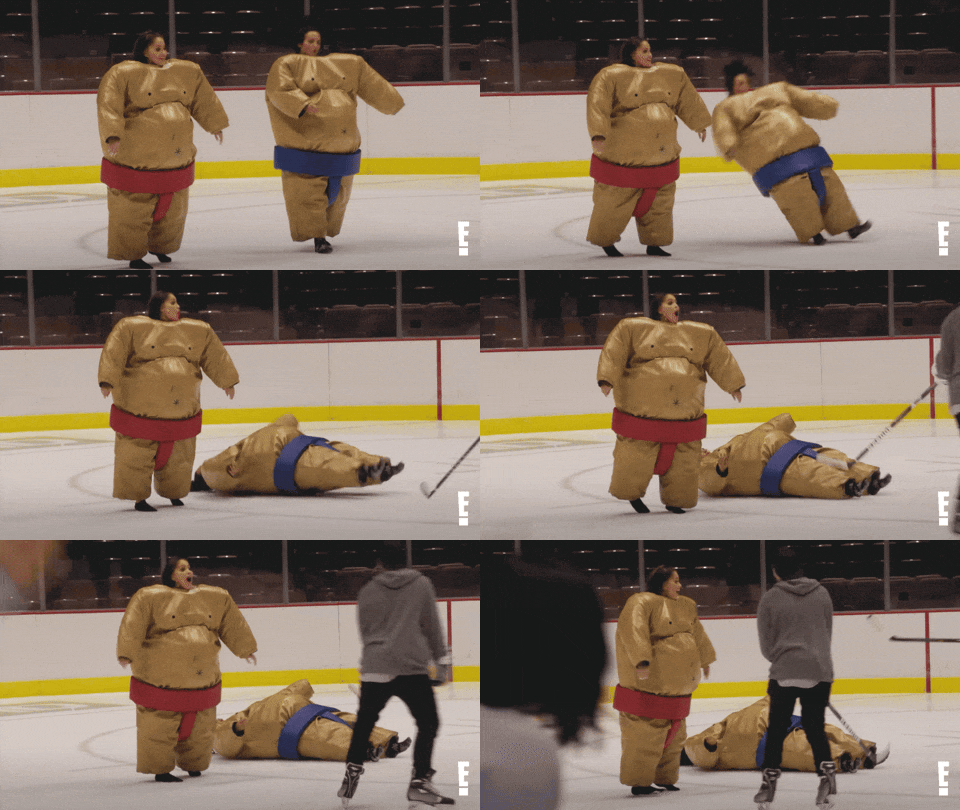
Our walk to the venue We played the Parkinson’s singles event first. I finished third in my qualifying group winning 2 matches and losing two, narrowly missing out on qualifying for the knockout round. Instead I played in the consolation knockout, reaching the final, and winning a very close match in 5 sets. A good day, rounded off with an event gathering for dinner on Saturday evening.
On Sunday we played a handicap singles event with both Parkinson’s and non Parkinson’s players involved. I was given a very generous handicap which caused raised eyebrows in the other three players in my group (all non parkies). However they took the challenge on in good spirit and we had a very enjoyable group set of matches with me topping the group. I then won my first knockout tie and lost the next one in the round of sixteen. The handicap competition was the highlight of the event for me as it was played in great spirit with everyone having fun.

Seppo and I having fun modelling our event T shirts
After the event we headed back to Gothenberg by train, having been driven to the station by Kjell Ake Waldner brother of… those that know, know. I then had a few enjoyable days holiday in Gothenberg before heading home at the end of the week.
Medication
During competitions it is always a challenge to remain fully medicated, in the “on” state for the duration of the days play, particularly as the timing of matches can be difficult to predict. During this trip I started to notice that the efficacy of my medication was beginning to reduce and not just on playing days. More on this later.
Yes there is more!
Also in February I managed to attend meetings separately with the PUK Scotland Physical Activity Officer, and the Table Tennis Scotland Community Project Manager discussing activity options for PWP. We also had the first meeting of the small team who are organising the Parkinson’s Scottish Table Tennis Open taking place at Inverclyde in August. I even managed to see a couple of Rugby Internationals at Murrayfield, thank goodness this is a leap year otherwise February would not have been long enough!
MARCH
Walking Football
March began with a photo shoot at Hampden Park in preparation for the launch of an agreement between Walking Football Scotland and Parkinson’s UK that will create more opportunities for People with Parkinson’s to participate in Walking Football.

Drew Wilson, Walking Football Scotland, Amanda McKay, Parkinson’s UK, Rose Reilly MBE, myself, and Kenny McLean, President, Walking Football Scotland.
Group Meetings
At our monthly Glasgow Support Group meeting we had a presentation delivered by the Glasgow Memory Clinic on Parkinson’s research and development, which was both interesting and thought provoking.
The following week I was invited to speak at the AGM of the Parkinson’s UK Edinburgh Branch. I spoke briefly about my Parkinson’s journey and my role as trustee for Scotland.

Speaking at the Edinburgh Branch AGM
TT Events
I spent a couple of Sundays this month in sunny Bathgate taking part in TTS Veterans events at Bathgate Academy. Firstly a banded event where players are placed into groups by band and play a round robin against each other. I was in a group of 8 in Band 5 and won two matches. My previous outing was in Band 8. The second event was the Scottish Vets National Championships, where I was less successful but enjoyed the experience.
Dunlop Parkinson’s TT Visitors
I participated in a visit to the recently introduced Parkinson’s TT session at Dunlop TT Club. Present were, Caroline Rassell (CEO of Parkinson’s UK),Alan Brown (MP for Kilmarnock and Loudoun), Tanith Muller (Parliamentary and Campaigns Officer – Scotland at Parkinson’s UK), Brian Carson (Parkinson’s UK Board of Trustees and Chairman Parkinson’s Table Tennis Scotland) and Stuart Wallis (Community Project Manager – Table Tennis Scotland) joined us to get a better understanding about the work the club is doing, especially for people with Parkinson’s disease in the region.

Host Martin Oestmann with the visitors
Medication Update
I mentioned earlier that the efficacy of my medication was reducing. On numerous occasions recently my “off” times have been increasing and the four hour coverage of each medication dose was at times being reduced to two hours. This was particularly prevalent when I was involved in vigorous exercise. Additionally some of the “off” times were arriving with no warning, like a switch being thrown. On one occasion during a league match I was fine at the warm up and during the first set of a match. But early in the second set the switch was thrown. I could not put any pace or spin on the ball and my movement slowed down severely. I had to adapt to a blocking and pushing game which is alien to me and inevitably lost the match, and the next one. I took medication as soon as the “off” period began but it can take up to an hour to kick in.
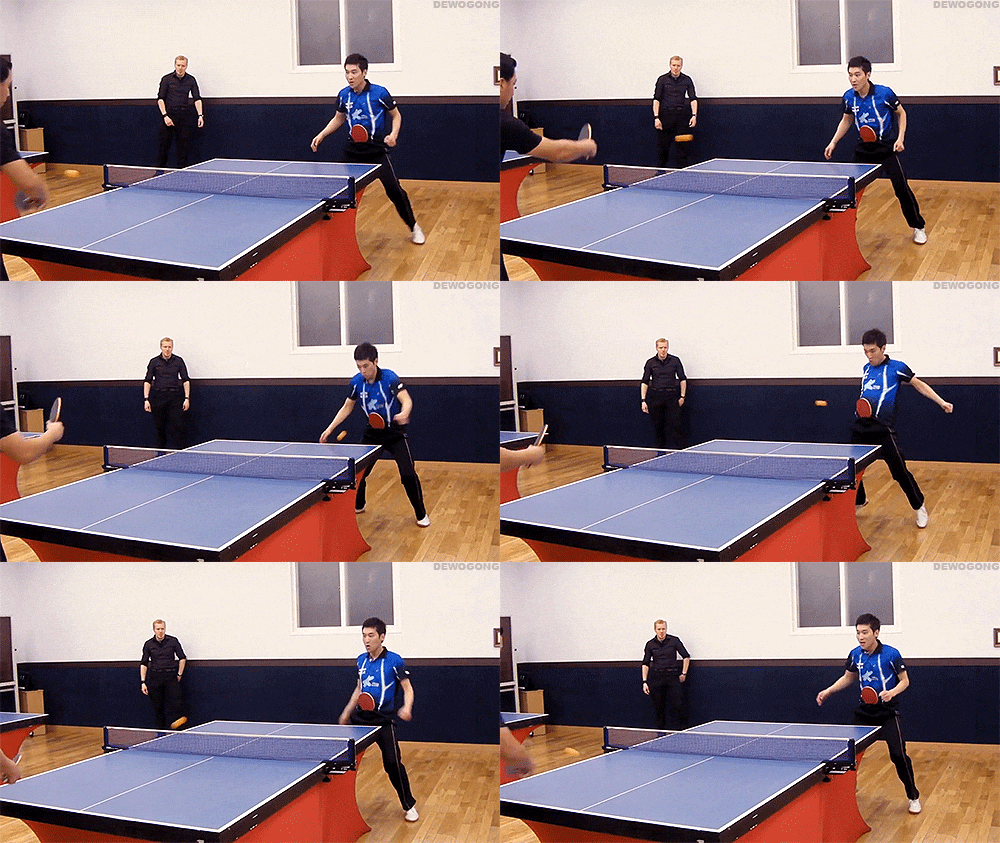
One playing option when in the “off” state. I have since had a review with my Parkinson’s Nurse and the daily dose one of my medications has been increased and the period between doses has been reduced to improve coverage. An additional medication to improve daily coverage is also being introduced.
Increases in medication are always troubling to me personally, as I view them negatively as a step to address deterioration in my condition and this moves me closer to a time when more drastic treatment will be required.
However I fully respect and trust the medical team responsible for my care and know this is the correct option to maintain my quality of life at this point.
Summary
A very busy start to 2024 for me but I would not want it any other way. As I write I am excitedly waiting for the birth of my granddaughter, my first grandchild. I am anticipating this will make the next three months and beyond even busier, happier and more rewarding as I get to know her.
For now it’s continue with the Easter break, and breath.
If you or someone you know is affected by Parkinson’s, and you need advice, call the Parkinson’s UK helpline on 0808 800 0303. It’s open from 9am to 6pm, Monday to Friday, and 10am to 2pm on Saturday.
End -
Walking Football, A Parkinson’s Perspective
A Blog by Brian Carson 29 June 2023
All opinions are my own.
Background
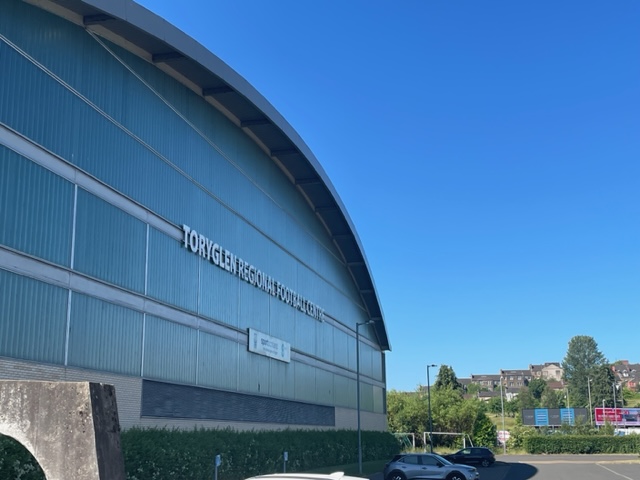
Just over 18 months ago I participated in a pilot scheme to introduce a weekly walking football session for People With Parkinons’s (PWP). This pilot ran for 10 weeks and was a joint venture between Glasgow Life and Parkinson’s UK Scotland. The sessions were held at the Toryglen National Indoor Football Centre.
As reported in a previous blog, this was a great success and it was agreed to continue these sessions on a permanent basis. Glasgow Life issued a very detailed report on the structure of the sessions. The content of the sessions was created in collaboration with Parkinson’s Specialist Physiotherapists to ensure it was tailored for PWP. The report described how the sessions were adapted during the pilot to provide maximum enjoyment and benefit for participants and how they continued to develop as the sessions progressed to maintain and improve these criteria. The report also contains details of quantifiable improvements in mobility and mood in participants over the ten week duration.
Earlier this year The Celtic FC Foundation joined this partnership and are funding these sessions for 18 months. This has given the sessions an additional boost and the participant numbers are steadily growing.
These weekly sessions are very well structured and organised and are always supported by 4 or 5 coaches some of whom are volunteer coaches.
Weekly Sessions
A typical session consists of the following:
- A dynamic warm-up including stretching and movement.
- Drills and coaching sessions. These are varied weekly and focus on various aspects of the game and some of the symptoms of Parkinson’s. eg movement and balance, situational awareness (where the individual is on the pitch and where team mates and opponents are), confidence and voice projection eg talking loudly to team mates when giving and receiving the ball, plus many other aspects.
- A game of walking football for 20-30 minutes where the lessons from item 2 above are put into practice. There may be two separate games depending on numbers.
- A warm down.
- A get together over tea/coffee for some social interaction. (and friendly abuse 🤪)
Note: The number of coaches is particularly significant for items 1, 2 and 3 as this allows for some individual 1 to 1 support to be provided for participants where the severity of their symptoms and range of movement requires this.
These sessions are varied, challenging and great fun to take part in. As if that was not enough they also provide physical, mental and social benefits to the Parkinson’s participants which helps us to manage the condition.
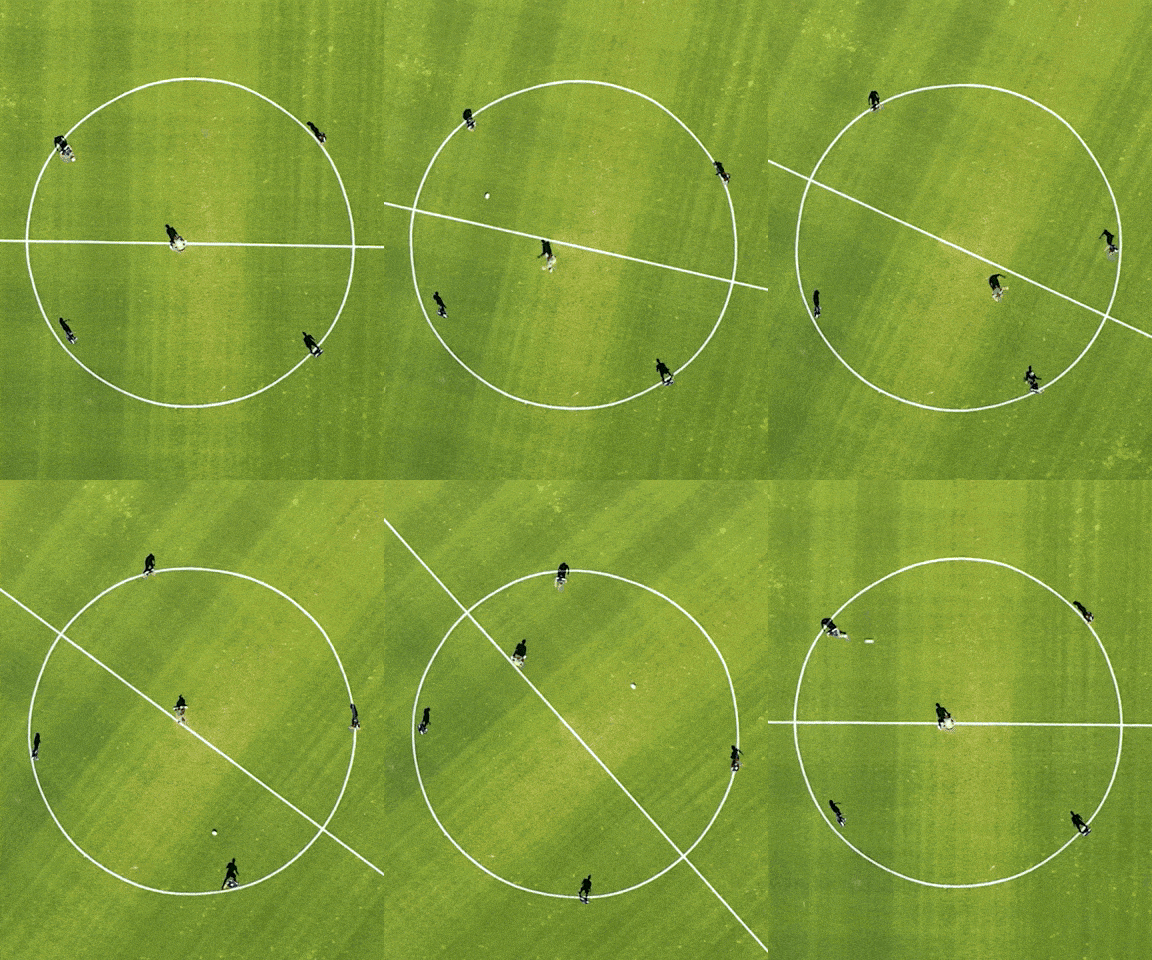
How we think we play. 🤩 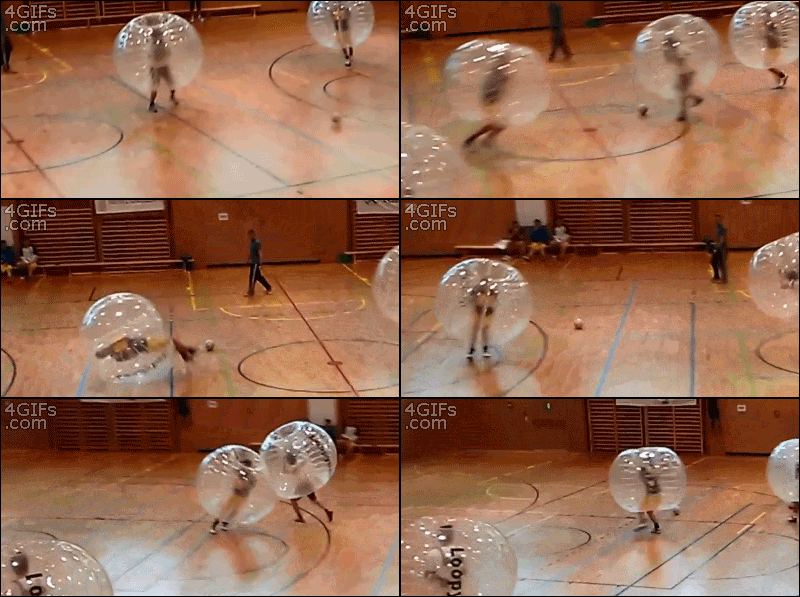
How we actually play 🤣 Training Update
Over the last few weeks the focus of the sessions shifted slightly as we had entered a Parkinson’s team into an event that meant we would be playing against non Parkinson’s teams. More importantly we would be playing strictly to the rules of walking football, and with an official referee who would enforce these rules. This in no way removed any enjoyment from the sessions, apart from the abuse I got everytime I started running, but it did give us a bit more focus on playing as a team and strictly to the rules of the game.

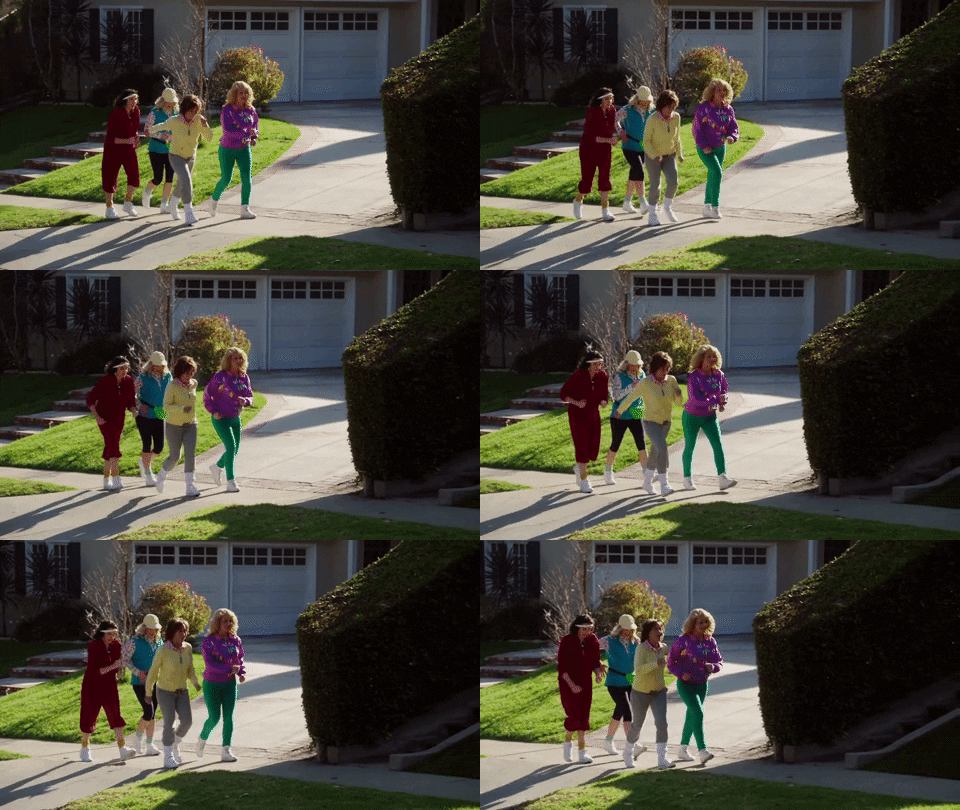
Me getting carried away, again! 😒 The Event
On the Saturday 24th June the largest one day walking football event in the world was held at Glasgow Green, The Walking Football Scotland 2023 Walking Football Festival.
The event was held at the Glasgow Green Football Centre and was a mixture of competitive competitions and a non-competitive festival featuring 76 teams an almost 800 players
The categories and winners, where applicable are listed below:
Over 50’s Scottish Cup – Pollok Utd
Over 60’s Scottish Cup – Ayr Utd
Over 65’s Scottish Cup – North Lanarkshire Council
Over 70’s Scottish Cup – North Lanarkshire Council
Over 40’s Women’s Scottish Cup – Braehead FC
Over 40’s Non-Competitive Festival (Peter Collins Fair Play Award) – Chest Heart Stroke Scotland
A full report of the day is available at the link below:
https://www.walkingfootballscotland.org/news/2023/6/27/wfs-scottish-cup-amp-festival-2023
Our Parkinson’s Team played in the Over 40’s Non-Competitive Festival.
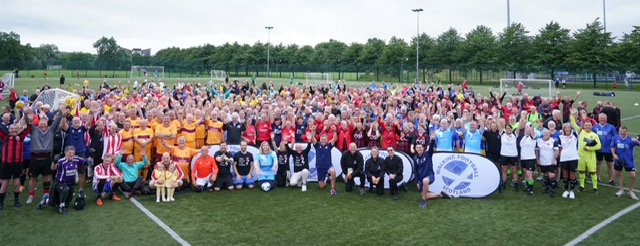
All of the players (Almost 800)
The “Competition”
We were in a group with 4 other teams and played a 20 minute game against each opponent. Originally we were scheduled to play 5 games of 15 minutes duration but a late withdrawal of one team from our group necessitated this change.
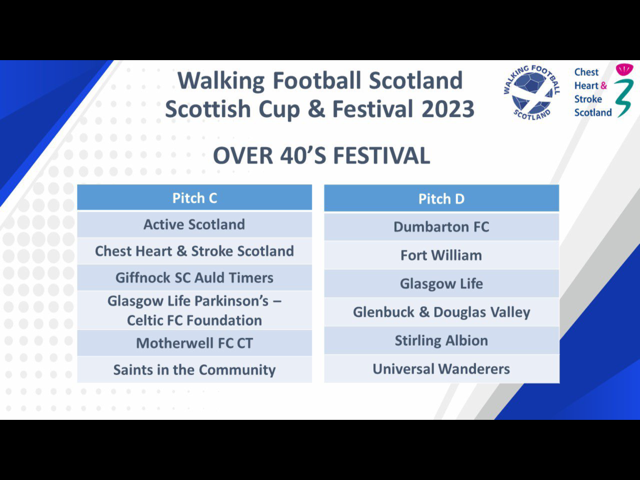
Our Original Fixture List (Pitch C) All games were six a side and we had eleven players available who have Parkinson’s. One of the volunteer coaches joined the squad as a second goalkeeper, therefore we could change out each team at the mid point of each fixture.
A 20 minute game of walking football does not sound too taxing but we had to consider our various ages, levels of mobility and fitness, and the need to manage medication routines. Therefore having the flexibility provided by this number of players was a necessity, and that is without factoring in the temperature on the day which at times reached the mid 20’s centigrade.
The games were billed as non competitive but once you get on the pitch you want to play well, both individually and as a team, and you want to win. The adrenalin kicks in and before you know it you are exhausted.
A Parkinson’s Team counter attack 🫣 All of our games were played on a caged or enclosed pitch, surrounded by a backboard. The ball can be played against the backboard which can be an advantage to “get around” opposing players. The downside of this enclosure is that the ball never leaves the playing area, i.e. it is always in play, therefore there is no down time during games to get a breath
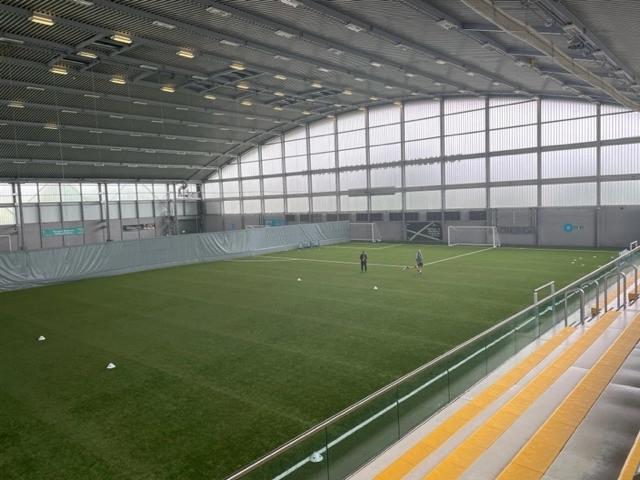
The size of the pitch in my head after 10 minutes play
Results
Our results were not what we hoped for but in the cold light of day I now think we did very well and played some good football at times.
We were well beaten by Motherwell FC CT and Active Scotland who were both very experienced and mobile teams. We had a draw (4-4) with Chest Heart & Stroke Scotland, and we narrowly lost our final game to Giffnock SC Auld Timers (4-3).
Ken (Ibrahimovich) celebrating a goal 👍
On the plus side we had fantastic day playing football and having fun as a team, some for the first time and for others a chance to do something we thought was way in our past and no longer possible.
It can be energy sapping 😊 We certainly all got a buzz from being part of this event and our group chat was on overdrive well into the following day as we reflected on the experience and shared our thoughts about what we had achieved.
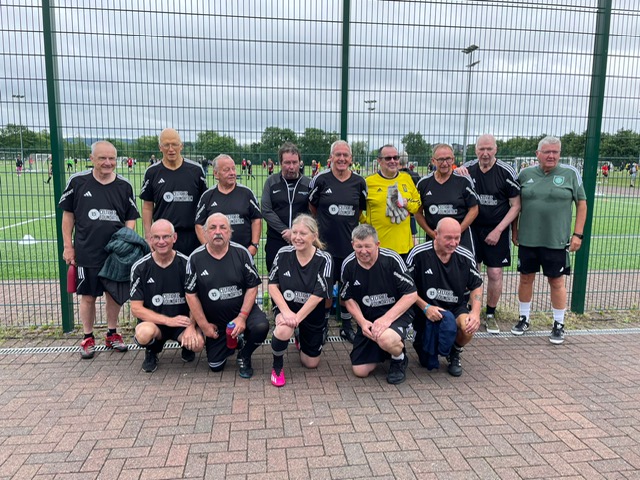
The Parkinson’s Team Players and Coaches Back Row L to R
Tam – (David Beckham) up and down the right wing all day
Ken – (Zlatan Ibrahimovich) left midfielder can score from anywhere
Stevie – (Tommy Mclean) pocket sized dribbling winger
Ricky – (Pep Guardiola) Super coach and motivator. Quote of the day “shoot from anywhere their keeper is as blind as a bat”
Brian (me) – (Frank Lampard) box to box utility player, unfortunately more wine boxes than penalty boxes.
James – (Alan Rough/Gandalf) Enthusiastic goalkeeper who threw himself at everything, “you shall not pass”.
Eric- (Lubomir Moravcik) Midfield genius who sees things on the pitch that us mere mortals don’t
Brian (not me) – (Gordon McQueen) silky skills no pace (non of us have any) but plays with his head, not literally
Drew – (Maurice Johnston) Lead coach with an identity crisis, blue nose in a green tracksuit. Thinks he is Linford Christie at the training sprints.
Front Row L to R
David – (Bobby Charlton) energetic midfielder who covers every blade of grass
Jim – (Scottish Maradona) Volunteer coach and brilliant extra goalkeeper for the day
Joy – (Gerd Muller) Poacher and goal scorer extraordinaire
Duncan – (Duncan Ferguson) Solid, skilful and takes no S*** even from his own team
Davie – (Franz Beckenbauer) super sweeper who organises the team from the back but likes the sound of his own voice too much! 🤣
Thank You
Thank you to Glasgow Life, Parkinson’s UK Scotland and the Celtic FC Foundation for organising and supporting these weekly sessions.
Thanks also to the coaches for your time and patience. You push us hard but you always make it fun. This incudes volunteer coaches Russell and Peter who are not in the photograph as they were playing for their regular teams on the day.
The support from the touchline from everyones family and friends was fantastic and kept us going, you were all so positive and encouraging
Finally a big thank you to the Celtic FC Foundation for providing the kit we wore on the day. Not only did it make us look like a team, but more importantly it made us feel part of something and helped us to play as team.
What Next?
In October we have a Parkinson’s Walking Football Festival taking place in Toryglen with teams from around the UK taking part. This is not on the scale of the Festival but hopefully we will have several teams entering. The anticipation is building already.
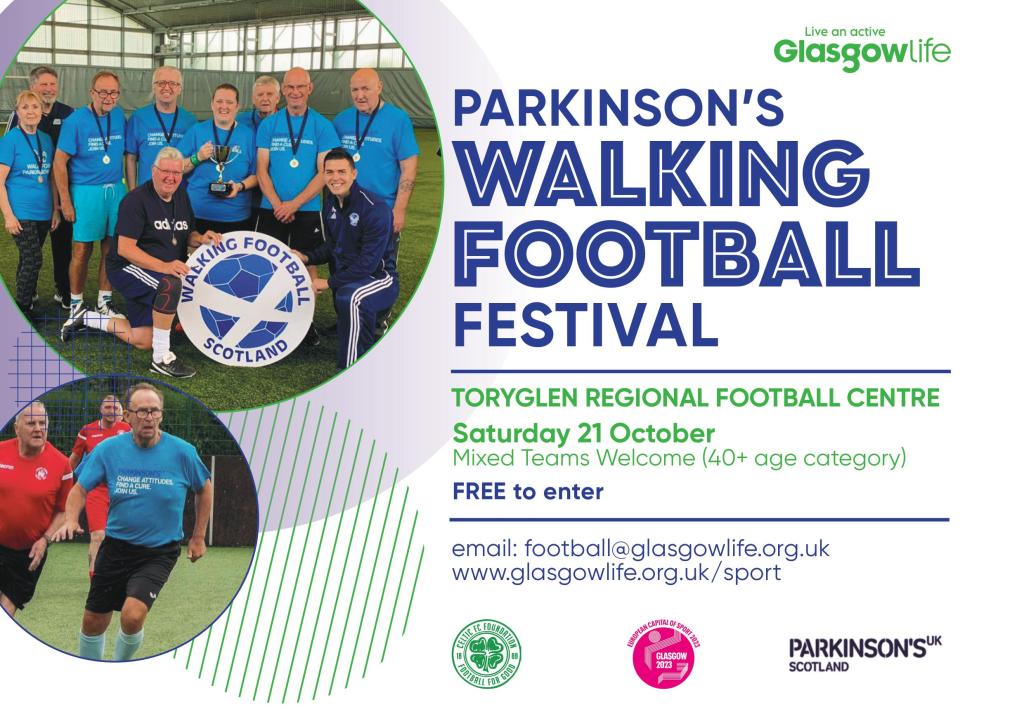
In the meantime the weekly sessions will continue at Toryglen and hopefully the numbers will continue to increase as we spread the word on the benefits and fun to be had at these sessions.
If you have Parkinson’s and would like to try walking footbal come along to the Toryglen Regional Football Centre in Glasgow Thursday’s at 11am. You are guaranteed a warm welcome.
End
-
Parkinson’s Disease – My First Six Years
A Blog by Brian Carson
1 June 2023
All views in this Blog are my own.
Six years ago to today I was diagnosed with Parkinson’s Disease. This was not entirely a surprise as like some people I googled the symptoms before attending the neurology appointment and was expecting this diagnosis. That is not to say it wasn’t a shock and raised many questions. Why me? What are the causes? Is this not an old persons condition, (I was 54 years old)? Is it hereditary? Is my life as I know it over? Etc.
I am sure you can imagine how this affected my mental state at the time. I went from knowing very little about the disease, to probably knowing too much in a very short timeframe after a period of intense research. Three things stand out from the research I conducted into the condition.
- There is no cure but medication is available to help manage symptoms.
- The range of symptoms is vast (over 40) and no two people have the same “mix” of symptoms making the pace and effects of progression very difficult to predict.
- The pace of progression “may” be reduced by taking regular focussed exercise
If I tried to describe the last six years in detail it would fill a book, and maybe it will some day!
The major points are –
- I was diagnosed with Parkinson’s.
- I retired from work as a result,
- Sadly I became a widower after being married for 37 years.
Two major life changing events in a short space of time was difficult to cope with. Sometimes it was very easy to withdraw and on occasions my mental health has suffered as I have tried to come to terms with my situation and if I am brutally honest some days it can be a challenge to get out of bed and face the day. Thankfully the number of days when I feel like that is getting fewer and fewer.
I am fortunate to have such supportive family and friends who have kept me going through a very challenging period.
If there was ever an upside to having this condition it is the people I have met, both with and without Parkinson’s, the community of support both at home and further afield that I have become part of, and the friendships I have made. Most of this has come about through groups that I attend and contribute to and activities I participate in. Sometimes I feel like a Parkinson’s novice as I have friends who have been living with this condition for many years longer than I have, in some cases 20 years plus, and they just keep going to live the best life they can.
The past is very important to how I came to be who I am and where I am today. Yes this is not the life I (we) had planned for and the person I planned to enjoy it with is no longer with us.
It is however the life I have and I will continue to live it doing the things I enjoy, for as long as I physically able, with the friends, family, and the Parkinson’s community who have supported me and helped me to get this far.
The range and diversity of support resources available for People with Parkinson’s has improved dramatically in the short time I have had the condition and continues to grow. This includes support to those newly diagnosed, an ever increasing portfolio of activities and sports, and numerous support groups in various locations around the country. These resources are being provided through a number of organisations, including the various health boards, exercise and leisure activity providers, and great charities like Parkinson’s UK.
There are also some really positive research projects being progressed that will provide additional support in the next few years. Not necessarily a cure although we live in hope, but medication that will provide more help with managing symptoms, and in some cases reduce the side effects of some medications currently in use. When available these products will further improve the quality of life for PWP.
I have no idea what the future holds for me personally in terms of progression.
I have said previously when discussing my condition in presentations to various groups that Parkinson’s is life changing not life ending. That is a very important mantra to me personally as I face up to the next 6, 12, 18 years, and hopefully beyond.
What I can say is in my future is continuing to volunteer with the various Parkinson’s groups and organisations that I enjoy being part of and contributing to. And of course continuing to be as active as possible, yes this means more and hopefully better table tennis 🏓, walking (sometimes running) football ⚽️, golf ⛳️, Pilates 🧘♀️, PD Exercise 🏋️♀️ , cycling 🚴♀️, socialising 🍺, and travel ✈️😎.
Parkinson’s – never give in💪.
End
-
2023 PPP German Open
A Blog by Brian Carson
27 May 2023
All opinions in this Blog are my own.Part 2 of my trip was to Düsseldorf to play in the third PPP German Open, my second time at this competition.
Travel
I have mentioned previously my anxiety about air travel and as this trip was not to or from the UK I was probably more anxious than usual. When I arrived at the train station at 05:30 to find all trains cancelled it did not help. However the train company were prepared and I was directed to a (train replacement) taxi with two other travellers and arrived on time for my flight.
At this point I would like to thank all of the Brexit voters out there for the added time and scrutiny you have introduced to European travel for UK citizens 🙁. A gift that keeps on giving! When I arrive anywhere from the UK I have to join very long queues and face additional scrutiny at customs because of my non-European passport. This was the case when I arrived in Sweden. However, when I arrived in Düsseldorf on a flight originating from Sweden I was waved through like royalty and was out of the airport within 15 minutes of landing!
On arrival I met with Elizabeth Ildal from Denmark. We had both played in the Berlin Championships in 2021 but had not met other than through social media. We arranged to travel together to our hotels and subsequently arranged to have lunch and do some sightseeing in the afternoon as this may be our only chance to see some of the city before the competition started.
We had a nice afternoon together and I found Elizabeth to be a formidable, focussed, and very likeable person who was a driving force in the organisation of the first PPP World Championship in New York in 2019. I followed her progress through this competition and she played very well in her first competition for two years winning silver medals in singles and doubles and a bronze medal in mixed doubles. 👏👏


Sightseeing in Dusseldorf, briefly!
The ArenaLate in the afternoon as more players arrived we answered a request to help set up the venue. This was our first look at the venue which is the home of the Borussia Düsseldorf TT Team. There was almost 40 tables in two halls and it looked very impressive and I couldn’t wait to play.

I did not have to wait long. The venue set up was all but complete and there was nothing for us to to and we took the opportunity for some practice before an early dinner in readiness for the competition beginning on Thursday
Player Rankings
The rankings and classifications were released earlier in the week and I was “reclassified” from class 2 last year into class 1 this year. I wrote to the organisers asking for this to be checked and changed back to class 2. The answer was that my rating merited the change. Last year in a class 2 group of 32 players I was in 5th position after round one, playing 6 matches using the Swiss system, and finished in third place after the knockout round having reached the semi finals.
There is also a big increase in player numbers and most new players will start in class 3 necessitating players to move up classes to keep the groups balanced in numbers. The rankings put me at position 22 in class 1 which sounds respectable. However I have a rating of 1215 and the no 1 player has a rating of 1713, no 2 has 1524, and no 3 has 1510, the lowest is 1018 which is quite a spread if you discount some unrated players. I was not alone and there was at least 6 players new to class 1 this year.
PPP German Open Day 1
A relaxed start to the day as the competition start time was 2pm. We arrived mid morning to register and this was a great opportunity to catch up with other players as they arrived.
We had a very busy opening ceremony with lots of speeches from various dignitaries which lasted almost an hour. Not ideal to be sitting on benches for an hour immediately before competing when you have Parkinson’s, but this is part of the process and there was some update on the relationship with PPP and the German TT Federation, which has at times been fractious..

Opening Ceremony 
Opening Ceremony The competition commenced at 3pm with the singles competitions.
I played the initial class 1 group games and lost all 3 matches. 🙁 A quick end to my singles competition. My head did go down a bit but I did not play badly but was facing a new level of opponents. All of the players who moved into class 1 from class 2 suffered the same fate.
On reflection there is much I can do to improve but there is only so far I will be able to climb in this class. This is not defeatist but is based on the reality of the situation. There are a mix of TT players in this community. Many are like myself who started playing after receiving a Parkinson’s diagnosis. However there are a number of players who have been playing to a very high level before they got a Parkinson’s diagnosis and the gap in skill levels between these two groups is wide. My goal is to keep training to close this gap as much as possible, recognising that I will never have the same years of experience as these players.
PPP German Open Day 2
A much better day for me. I started the morning playing men’s doubles with my German partner Frank Schliwinski. I was only able to find a partner at the last minute and we met for the first time when we were called to start our first match together. I don’t speak German and Frank doesn’t speak English, what could possibly go wrong?
Surprisingly we played well together and won all 3 group games only dropping one set and qualified for the quarter finals on Saturday.

Playing doubles with Frank In the afternoon I played in the men’s Class 1 consolation singles group matches. In the first match I really struggled to cope with my opponents style of play and was 2-0 down before I got to grips with it evenually winning the match. I lost my second match to Morten and won the third to qualify for the knockout round on Saturday.

Consolation singles, can’t believe I am about to go 2-0 down, neither can Bjarne who was watching. (I eventually won 3-2) 

Singles with Morten
Late afternoon I played in mixed doubles with fellow Scot and good friend Joy Paul. We lost 3 very close matches in a tight group. The last match finished after 8pm and by that time I was running on fumes. Mixed doubles consolation matches were also scheduled for Saturday which is meant another full day ahead.
Doubles with Joy against Thorsten and Marita We had to abandon a dinner planned with the Swedish team on Friday evening as we did not return to the hotel until after 21:00 and we were all fatigued and in my case feeling the effects of medication adjustments made throughout the day to cope with the long schedule.
PPP German Open Day 3
First match was mixed doubles consolation semi- final with Joy against Swedes Eva-Lena and Erik. It took 5 sets and saving 2 match points in the final set to get the win. At 8-10 down in the fifth set I was resigned to losing after missing the table twice in a row. Not Joy though, she played two great serves to drag us level and get us the victory. The final is was scheduled for Sunday morning.

Post consolation semi final with Eva-Lena, Erik and Cecilia In mens doubles Frank and I lost the quarter final in 3 sets to a very good team, we just had no answer to their superior ability.

Thorsten Boomhuis “The Boss” 
Peter and Jesper the Danish Duo Low point of the day was losing my consolation singles quarter final 2-3 after being 2-0 ahead. A Pushing/ chopping game against anti spin and pimples, a nightmare I am sure I heard snoring from the spectators during this one.

After defeat by Volker Now for the event party.
A great night. good food, a few drinks (mindfull we had a final on Sunday) and music, and possibly too many speeches (in German)? At least the music provided an opportunity to practice my dad dancing for my daughters wedding later this year 😂. Later in the evening there was Karaoke which was our cue to leave before I got carried away and joined in. 🤪
PPP German Open Day 4
Joy and I played in the mixed doubles consolation final but it was not not to be and we lost in straight sets. We didn’t really get into the game which was disappointing as we played the same opponents at the group stage losing a tight match 3-2.

With Juliane and Kurt after the final However it was good to be still playing on day 4 of the competition and not just spectating.
We watched most of the finals and then the award ceremony at which Joy and I we picked up our consolation award for the mixed doubles. It may just be my ego but I always imagine the cheer is slightly louder when we are announced “from Scotland”. Joy collected a bronze medal for reaching the semi final of the class 1 ladies doubles with her partner Lin from Sweden. Well done to them both 👏👏.

Collecting our consolation award 
Joy and Lin receiving their bronze medals 
Enjoying the finals, It was too much for Damasio. It was decided that national anthems would be played at the end of the medals ceremony for medal winners. As the only winner from Scotland Joy was asked to stand at the podium on her own while God Save the King was played! I decided to join her for support. Just when we were about to stand down after the anthem they played Flower of Scotland 🏴 and we got to stand there twice as long as most other countries. Proud and cringeworthy at the same time. 😮

During “both” national anthems
Once again I have had a great experience with a fantastic group of people who come together to play table tennis, have fun and support each other. Yes we all have Parkinson’s but during these events that seems like a minor detail as we enjoy ourselves and and try our best to be competitive, but in a very sporting and friendly atmoshere.My focus now turns to the Parkinson’s Scottish Internation Table Tennis Open being held in Inverclyde in August.
End
-
Getting back to Activity
A blog by Brian Carson
Background
In my last blog I mentioned having an enforced break from physical activity while recovering from a hernia operation. As expected this was a difficult period for me personally and probably for those around me as they had to put up with my grumpiness about not being able to exercise. However by planning things to do other than exercise and having a positive attitude about my eventual return to activity, I managed to get through the down time with no real issues. It also helped that my down time was across the Christmas and New Year period when a lot of the organised activities I am involved in were unavailable during the holiday period. I certainly coped much better than I would have 3 months earlier when I was not managing my Parkinson’s so well, and struggling with my motivation to keep active.
My Route to Fitness
When I left hospital on 9th December following the operation I was advised to be as mobile as possible but take no exercise for 4 weeks and not lift anything heavier than 2kg during this period.
Within 2 days I was out walking but felt this was too risky because of the cold weather and ice. A fall could cause considerable damage so soon after surgery, therefore an alternative was needed.
Plan B was using a treadmill. I started daily (almost) 3k walks in the warmth and comfort of home. This kept me ticking over and feeling more positive about my recovery and the route back to the fitness levels I had before the surgery. Not to mention helping with the weight loss needed to get back to where I was previously.
Ten days after the op I went along to the weekly Parkinson’s Table Tennis session at Drumchapel Table Tennis Club. This was the last session of the year and we had a lunch party planned after the session. It was difficult to watch the session and not play and I eventually picked up a bat and hit a few balls, but just from a stationary position. From this point onwards I was itching to get back to playing TT.
I wasn’t as active as I should have been in the days immediately before and after Christmas (probably the same as most people). However, a few days after Christmas I attended a regular non Parkinson’s session at Drumchapel. I was sensible enough to hold back a bit in this session but it felt great to get back on the table and I had no issues during and after the session.
I continued to attend any available TT sessions over the next week and progressively increased my movement and effort at each one.
Four weeks after the surgery the doctor conducted a planned review and gave the go ahead to get back to my full activity routine. I didn’t share with him that I was probably up to around 50% of my previous routine activity by that time. Ahead of schedule but I had managed this carefully with minimal risk.
Next Steps
Fortunately this go ahead was given the week when all activity sessions got back to normal post the Christmas break. Now that I was officially “off the leash” there was no stopping me. That week I played table tennis (4 sessions)🏓, attended a PD exercise class🏋️♀️, and a Pilates class 🧘♀️, played walking football ⚽️, and even had a session on the driving range 🏌🏻where almost every ball was straight and long, although that will not last 😂.
I enjoyed every minute of every session but did get tired quickly sometimes, due to my lack of fitness. I appreciated that fitness would improve in time but being a bit impatient I decided to condense some activity over a week to help things along.
I opted to spend a week abroad in the sun at the end of January, cycling, running and walking, and enjoying the added bonus of some winter sun.
I set myself a daily schedule of cycling in the morning and running or walking in the afternoon. I managed to keep to this although by the end of the week I replaced the running with longer walks due to some knee pain. This sounds intensive but in reality I had time to have a leisurely lunch and catch up on some reading each day between sessions.
Exercising everyday is a challenge as there is not much recovery and rest time if there are zero days off. However over such a short time this was manageable and I had a few days down time for rest on my return home before getting back into my activity routine.
There was a downside as I was not able to play table tennis while I was away, (couldn’t find a table anywhere) and beer consumption for the week was probably a bit much from an exercise perspective.
However taking the big picture view, I had a great week in the sun, got some exercise and had some fun, and am confident that I am much fitter than I was the week before.
I have also had some great thinking time to consider what I do next. This included my activity routines, what table tennis events I want to play in this year, and what Parkinson’s activities I would like to be involved in. I will hopefully have more to say on this in a few weeks.
Activity and Parkinson’s
My friend and fellow PWP and TT player Steve Morley, recently published a blog titled “Why do you Train?”. This describes some discussions he has had on what motivates PWP to participate in physical activity. See quote below:
If the answer to the question Why do you Train is “to beat PD” then sooner or later I believe you will fail. You need a better reason to train: to run a faster 5km, to cycle 100km, to do an open water swim, whatever gets you excited. Then you will feel motivated to train despite PD, not because of PD.”
I agree with the first part of this statement in that we can’t beat PD as there is no cure, and if that is a motivation for activity then you have failed before you start.
However on the second part of the statement my view differs very slightly. My motivation is not to achieve faster times, longer distances etc, I see these as a by product of the activity. Yes if I am playing table tennis or football etc I am competitive and play to win, but that is not why I exercise.
My personal motivation to exercise is to have a level of fitness and movement that will allow me to “manage” my Parkinson’s for as long as possible on my terms, maintaining my quality of life. To do this I participate in activities that provide benefit, that I enjoy and have fun doing, and yes sometimes I do push the boundaries to improve. Remember, it’s not just physical benefit we get from these activities, but also mental and social benefit, which are also very important, but that is a discussion for another time.
I am not ignoring medication. I view medication and activity both as vital contributors in helping me manage my condition.
Awareness of Parkinson’s
I get a lot of encouragement and feedback to my blogs and posts about my motivation for what I do. Sometimes words and phrases are used that while are encouraging and supportive, make me realise that there is much more to do in raising awareness in the non Parkinson’s community of what this degenerative disease involves.
Most people outside the Parkinson’s Community have a view of what Parkinson’s looks like but don’t understand the complexity of the condition. For a lot of people the belief is that if you have Parkinson’s you will have some form of tremor, possibly stoop a bit, and be a bit slow walking and moving.
There are more than forty symptoms and as mentioned previously PWP have different combinations of some of these symptoms. It is important to realise that a lot of these symptoms are non motor and are therefore not visible. See my previous blog on Depression, Anxiety and Apathy, to name but a few.
Despite this it is possible to live well with this condition and many people do.
The illustration below is the perception some people have of Parkinson’s.
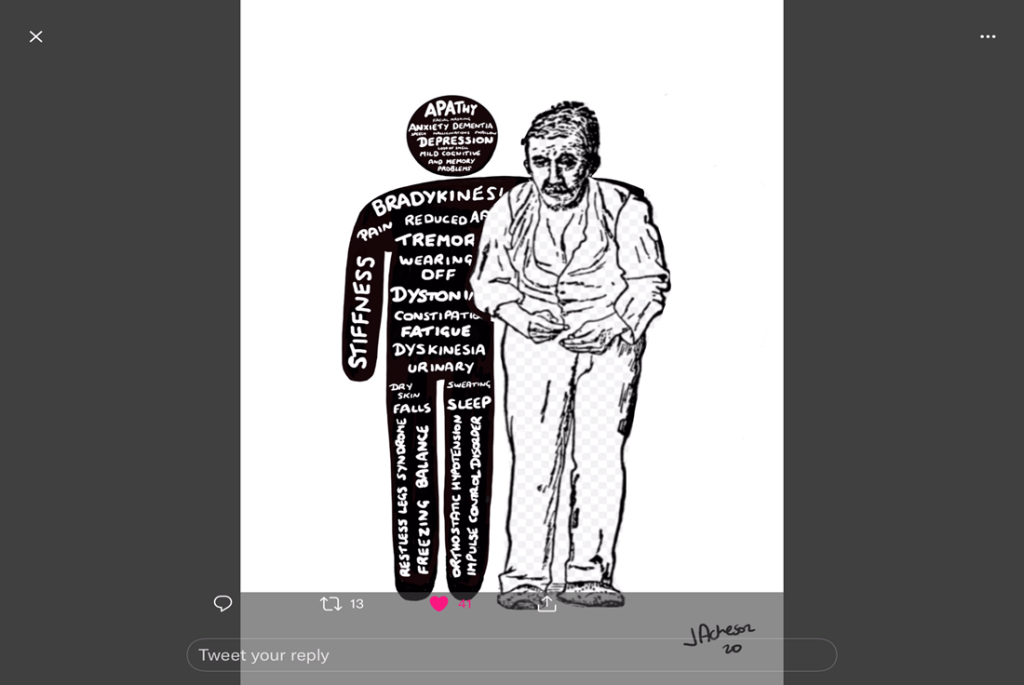
This is not me!
Note: Saying “we can’t beat PD” while true sounds very defeatist. I have stated in other forums that having Parkinson’s is not life ending, but is life changing. My personal view is that with the proper support and advice it is manageable for most people and that is what we strive to do.
Hopefully that message is what most readers will take from this blog.
End
-
Is it OK to not be OK?
A Blog by Brian Carson
Dec 22
The blog below was written in September this year. At the time of writing I was not coping well with my Parkinson’s. I had convinced myself that despite all the Parkinson’s focussed activity I have been involved in, deterioration as my condition worsened was inevitable. I began thinking that all the activities I participated in helped to promote would not make any difference.
Looking back now I can see how I got to this point as a series of issues and events, most of which in isolation probably seem minor everyday things, but cumulatively over a short period caused me to question my focus on dealing with my Parkinson’s.
In writing this blog at the time I took a major step in recognising I needed some help, and shared this with those closest to me.
I was not convinced I would ever publish this blog but now that some months have passed and I am much more like my old self I have decided to share this as it may help others who are or have been through similar experiences.
Is it OK to not be OK?
Written 11 September 2022
This is by far the most difficult blog I have written to date as it describes some recent struggles I have had coping with my condition. I have thought long and hard about publishing this as it contains some very personal information. If I do publish it will be sometime in the future when I am hopefully feeling much more positive. I do think it is important to share the down side of my condition, especially if it may help others with similar issues.
In recent blog I have mentioned some of the non-motor symptoms that are associated with Parkinson’s Disease and the impact these can have on the Person With Parkinson’s (PWP). Motor symptoms tend to be noticeable to most observers but non-motor symptoms are not generally visible and in most cases only the PWP is aware of these unless they choose to share this information.
The specific symptoms I am referring to are depression, anxiety and apathy, all of which are recognised Parkinson’s symptoms. I will attempt to describe how I have been affected recently by various events and the impact I have experienced. At this point I should remind readers the list of Parkinson’s symptoms numbers in excess of 40 and each PWP has a different permutation of symptoms.
My most recent blog was about the UK Parkinson’s Table Tennis Championship held in August, and the excitement and engagement of helping to organise and play in this event. The planning for this event started in March this year and this provided a focus for me as part of the Scottish Parkinson’s Table Tennis association in addition to all my usual activities for several months.
However, a few days after the event as everyone returned to daily routines I felt a bit “flat” and put this down to missing the buzz and activity of the previous few months. The following week I attended a funeral of a friend and found myself heading towards a new low as I got immersed in the sadness of the occasion.
Since the loss of my wife last year I have found the funerals I have attended to be emotionally draining on a scale I have not previously experienced. Not only do I mourn the deceased we are gathered to pay our respects to but I also get overwhelmed with my own sense of loss.
When Christine my wife of 37 years passed away last year the sense of loss was overwhelming. She was not only my wife, but also my friend, my partner, my companion, my conscience, mother of our children and the gap in my life without her is too painful to describe.
This may sound selfish but as I am a PWP Christine was also my “carer” and we had discussed many times how she would be around to help me as my condition deteriorated to a point when I would need constant help. With her passing I now have to face whatever comes with my Parkinson’s without her by my side. There are times when this is overwhelming, and the loss and loneliness become unbearable. Yes I have my son and daughter who have been incredibly supportive and continue to be but they cannot be with me 24/7, nor would I want them to be as they have their own lives to lead.
Additionally, as I write this blog I am on day 5 of a forced rest period due to a physical injury. In terms of my Parkinson’s this should not be a major issue but mentally this is a real challenge for me. I am always thinking that each day with no activity is an opportunity for my Parkinson’s symptoms to progress and get worse, and that any progression may not be recoverable.
What I am trying to describe above is a set of circumstances, that when combined with some recent personal setbacks, have driven me to a very low place in recent weeks that is unfamiliar to me. This has resulted in the symptoms of depression, anxiety and apathy becoming more dominant.
How does this affect me?
Firstly, I get anxious when I think too far ahead and create scenarios in my head of what my future might look like as my PD progresses. This is not conducive to a healthy mind but I find it very difficult not to think this way. I have a degenerative disease for which there is no cure and the last real medical breakthrough for this condition was 50 plus years ago when Sinamet was created, a drug that most PWP still take today.
In my opinion there is no chance of a cure being found during my lifetime. That is not a criticism of the incredibly dedicated and talented people who are researching and striving to find a cure. It is just my view and expectation.
Then I start to question the very active lifestyle I lead and that I was convinced is helping to slow down progression of my symptoms. Is this really the case? Yes I have had improved movement scores at my last 3 medical reviews, but can I produce empirical evidence that all this activity is the reason for this. No I can’t. Is it all in my mind? This breeds apathy. After a night with only 1 or 2 hours sleep (another PD symptom) do I really want to drag myself to a table tennis table or a football pitch to take part in an activity that I know is good for my overall fitness but that I cannot prove is helping my PD? Why bother when I feel exhausted?
So now I am anxious about what the future holds, have lost my drive to do something about it and depression sets in.
Again this is not a criticism of the fantastic work being done by the PUK Scotland Parkinson’s Active Team. Against all odds this small group have introduced a fantastic network of Parkinson’s focussed activity with various providers across Scotland and I have been very proud to be involved with this team.
Those of you who know me or have read previous posts will be familiar with Batman Brian, a persona I have created to get activity for PWP publicised and to encourage other PWP to get active. This makes me sound like a bit of an activity junkie who is on the move all the time playing sport, volunteering, doing interviews, competing in competitions, and getting a positive message out to the Parkinson’s community. Most of the time this is who I am, who I want to be and who people expect me to be.
The effort in maintaining this pace and this “front end” of who I am can take a toll which is where I currently am mentally. No one can keep this pace constantly and coupled with the thought of facing whatever comes my way in terms of facing my PD progression on my own is a daunting prospect.
Despite all this going on I have continued to get up each day and turn up for my usual planned activities, meetings, catch ups with friends etc etc, as I don’t want to let anyone down, and if I am honest I don’t want to be seen as failing to cope with my PD. But turning up and being me has been getting more and more challenging each day although deep down I think I know this is the right thing to do while I try and get some help.
So where do I go from here?
Thankfully I was able to recognise this dip and have spoken with close friends and family, who have been phenomenally supportive. The Parkinson’s community around me is also an incredible group of people some of whom I count among my closest friends, who are supportive and caring and have a wealth of experience of all things Parkinson’s,
This support and encouragement as well as the advice to seek help has been very comforting although I do confess the “seek help” bit did not sit well at first but I now understand that this is not a sign of weakness but a sign of strength in being able to admit I need help.
To answer the question in the title of this blog, of course it is ok to not be ok. This is a fact of modern life that we will all have to deal with at some point. The important thing is that if you realise you are not ok or someone else tells you they think you are not ok, be strong enough to seek help.
For me personally I think I am moving in the correct direction but still have a bit to do. If I feel it is appropriate, I will share some details of the help I have sought in the near future.
End of 11 September Content.
Dec 22
At the time of publication I am in week 2 of recovery from a hernia operation. Recovery includes a 4 week spell of no sports activity to ensure minimum opportunity for a recurrence of the injury. This is difficult for me to deal with when I consider what I need to be doing physically daily and weekly to manage my Parkinson’s. However, I am coping well as I realise and understand I need to play the “long game” in this situation and not get hung up on the potential impact of a few weeks down time from activity. I also want to start 2023 injury free and get back to my routine without issues.
Yes I am missing the activities, the social, physical, and mental benefits they provide, as well as the fun, but compared to how I felt three months ago after 5 days of no physical activity plus a number of other issues, I am so much more positive about getting back to my routine.
January may feel like a boot camp as I attempt to get back to fitness, and lose a few pounds, but bring it on. 🏓🏃♀️🏌🏻♂️🏋️♀️⚽️🧘♀️🚴♂️
Brian Carson
-
PP Parkinson’s Table Tennis World Championships
Pula, Croatia 12 – 16 October 2022
A Blog by Brian Carson
This years world championships took place in Pula in Croatia over 5 days. This blog is a description of my experience of the event. I was fortunate enough to attend and play as a member of a UK group of 11 players, 8 from England and 3 from Scotland. Additionally we had a total of 14 supporters accompanying us including my son and daughter and future son in law. This allowed us to have a family holiday around the competition
The tournament had a total of 165 participants, 107 men and 58 women from 19 countries.

The UK Players 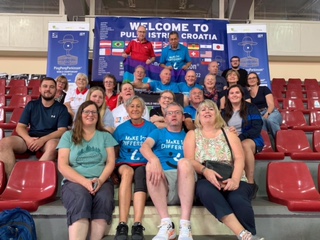
UK Players with Support Pre Tournament Preparation
I usually go into some intense training for these competitions in the weeks before, increasing my weekly TT sessions from 4 or 5 a week to 6 + a week across the three clubs I play in, South Ayrshire, Knightswood and Drumchapel., in addition to some practice at home.
However this time I actually reduced my playing time rather than increase it as I have recently had a hernia diagnosed and I have been carefully managing my playing time to give myself the maximum opportunity to be able to play in Croatia and be as competitive as possible.
This has also meant reducing other activities and I have kept away from walking football for a few weeks and scaled down my Pilates and PD Exercise with the help of both instructors.
Tuesday 11 October
We arrived in Pula early afternoon after an overnight stop in London. This was necessary due to limited flight options from Scotland. The UK team travelled separately from various locations and arrived at various times with some of the group travelling early to take advantage of the great weather and location for some pre tournament holiday time.
The competition dates were changed a few months before due to a clash with another TT event and this late change caused some delay in clarifying some specific event information until very near the start date. This impacted travel and accommodation arrangements for a lot of participants, and in my view resulting in groups being located at multiple locations around the area and making the social side of the event more challenging. At previous events we would be accommodated at a few specific hotels which helped us easily integrate socially. That is not to say we didn’t meet up and have some great social time.
Our first “event” was Tuesday evening and was a cocktail party at a beach bar where the majority of the players and their families and supporters got together to catch up. As I always say this is a great opportunity to come together as an international Parkinson’s community and catch up with old friends from previous events and meet new friends who are first time attendees at one of these competitions. For me personally this was a chance to catch up with my doubles partner Christoph Freyburg from Cologne, who I had not seen since we played together in Berlin in September 2021 although we keep in touch regularly.
Lars Rokitta thank you for giving me the photograph of you and I together in Portugal.
This was an early evening event and on completion a large number of volunteers went to the arena (the Mate Parlov Sports Centre) at the request of the organisers to help set up for the competition, assembling tables and barriers etc.
Wednesday 12 October Day 1
We had a couple of hours on the practice tables in the morning preparing for the competition start. I had a good session with my mixed doubles partner Joy Paul and it was great to get some practice time with my men’s doubles partner Christoph.
In the afternoon we attended the opening ceremony in the Roman Amphitheatre which was both unusual and fascinating to have this type of event in such surroundings. Although we were told it is used often for concerts so was probably not so unusual for the locals.
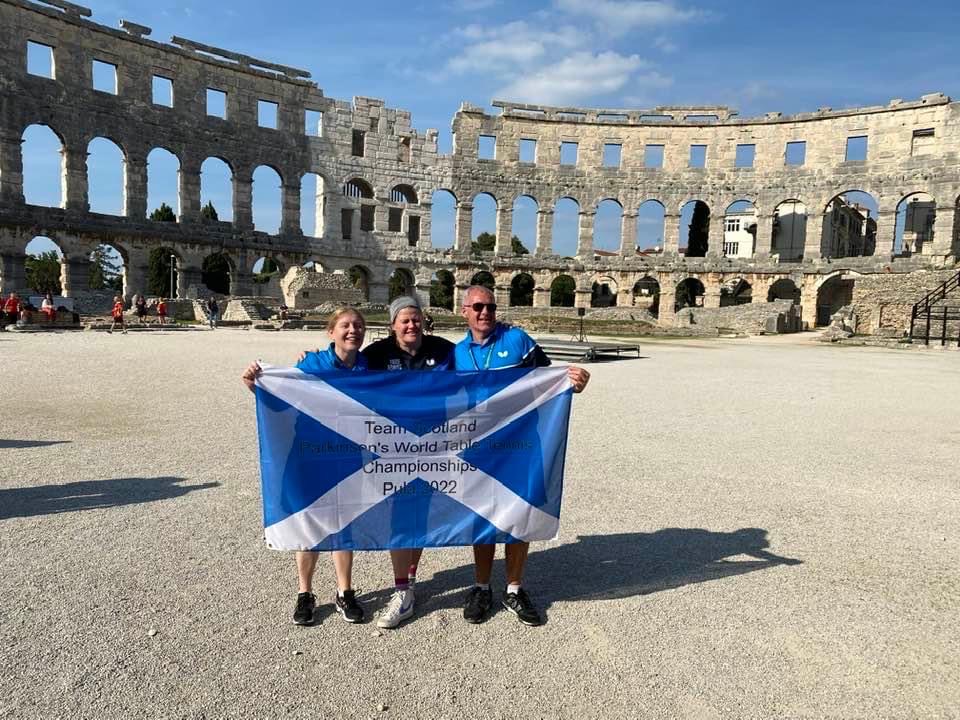
The Scottish Team at the Opening Ceremony Then late afternoon down to business as the mixed doubles competition commenced.
There were 5 competitions in total. Men’s singles and doubles, ladies singles and doubles, and mixed doubles. Each of the five competitions has three separate classification groups meaning there were fifteen separate competitions taking place.
Classification allocation is determined using a complicated questionnaire completed by each player and includes information about their Parkinson’s, time since diagnosis, severity of symptoms etc, as well as TT ability and level of participation where they normally play at home in clubs or groups.
There is usually an appeals procedure to allow allocation of classification to be challenged or clarified but I am not aware of any official responses to challenges made for this event.
All competitions were started in group format with the qualifiers moving on to knockout rounds through to a final. Similarly those who did not qualify moved on in a parallel consolation knockout competition which concluded with a consolation final.
My partner in this completion was Joy Paul who plays at South Ayrshire TT Club. Matches started at 17:00 and we were included in the class 1 competition, despite both being assessed as class 2 players for the singles competitions. This gave us quite a challenge and despite some great games we failed to qualify from our group, playing some tough opponents including the No1 seeds.
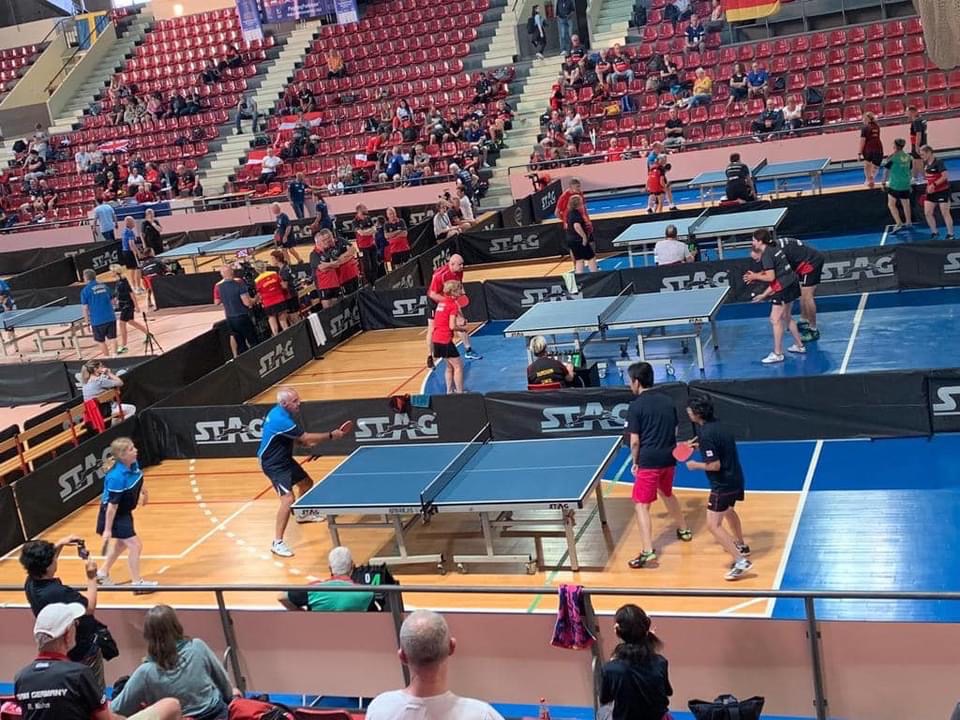
Mixed doubles Group Game against Hiromichi and Rie from Japan 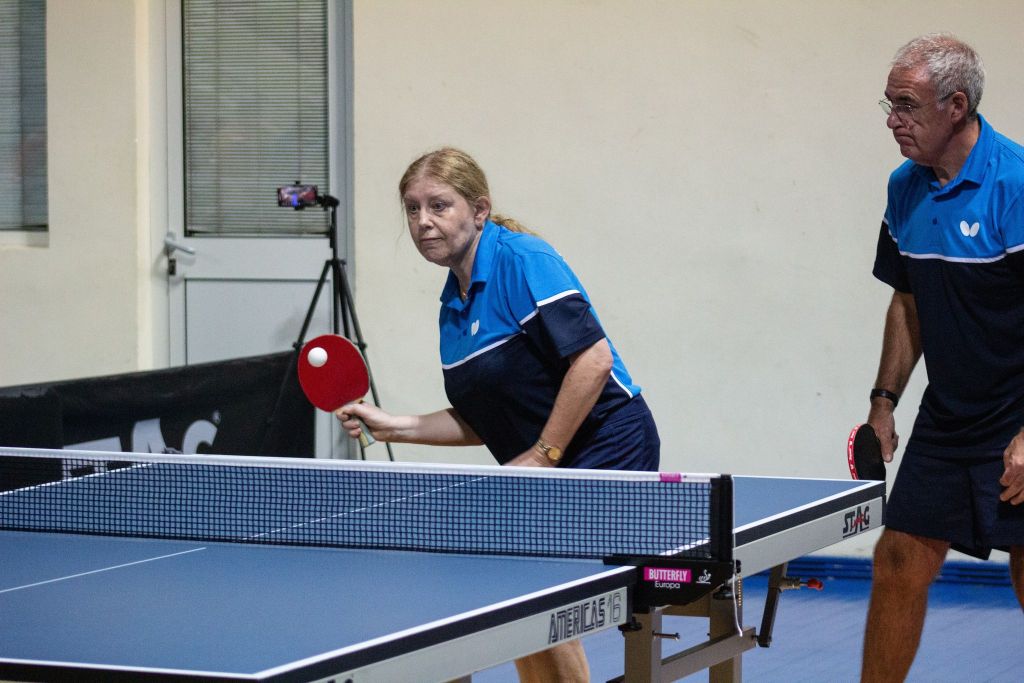
At least one half of the dynamic duo was dynamic, I look like a statue! Thursday 13 October Day 2
Play commenced in the men’s singles with all group matches played to determine who moved forward to the knockout stages in all classes. I was playing in class 2 and had a successful day finishing second in my group and qualifying for the knockout rounds on Saturday. My group contained players from the USA, Germany and Israel. As always I get a bit nervous when starting these matches, particularly the first one but this time I was much calmer than usual and hopefully this was reflected in my play.
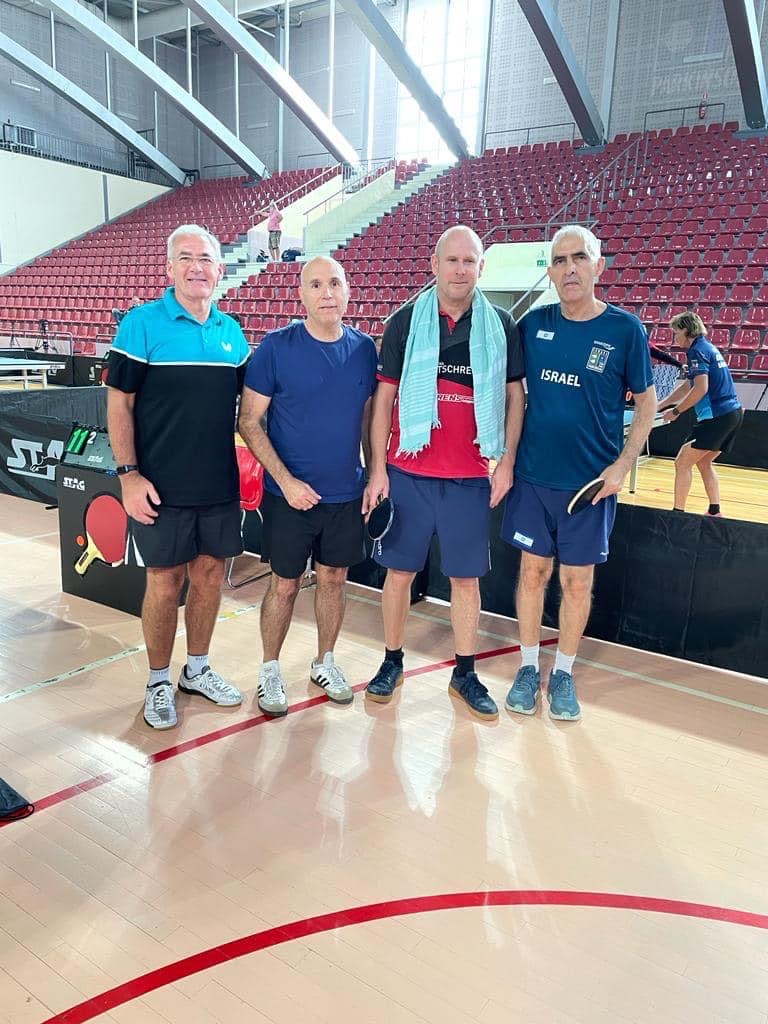
My singles group opponents, Michael – USA, Knut – Germany and Phillip – Israel Friday October 12th Day 3
Christoph Freyberg and I began our doubles campaign, hoping to continue our success in Berlin last year where we won a bronze medal in the category. We were in a tough group that included the number one seeds as well as the current world champions who we lost to in last years semi final. Again we were both class 2 singles players who were entered in the class 1 competition. I am aware this may sound like sour grapes but it would help everyone if the organisers responded to questions and challenges on classification allocation. Unfortunately the other teams were just too good for us and we could not qualify for the knockout stages, moving on instead to the consolation rounds. It was great to see Christoph again and to play with him as he’s has not been able to make any other competitions this year due to ill health.
Men’s Doubles Group Match against Holger and Norbet from Germany 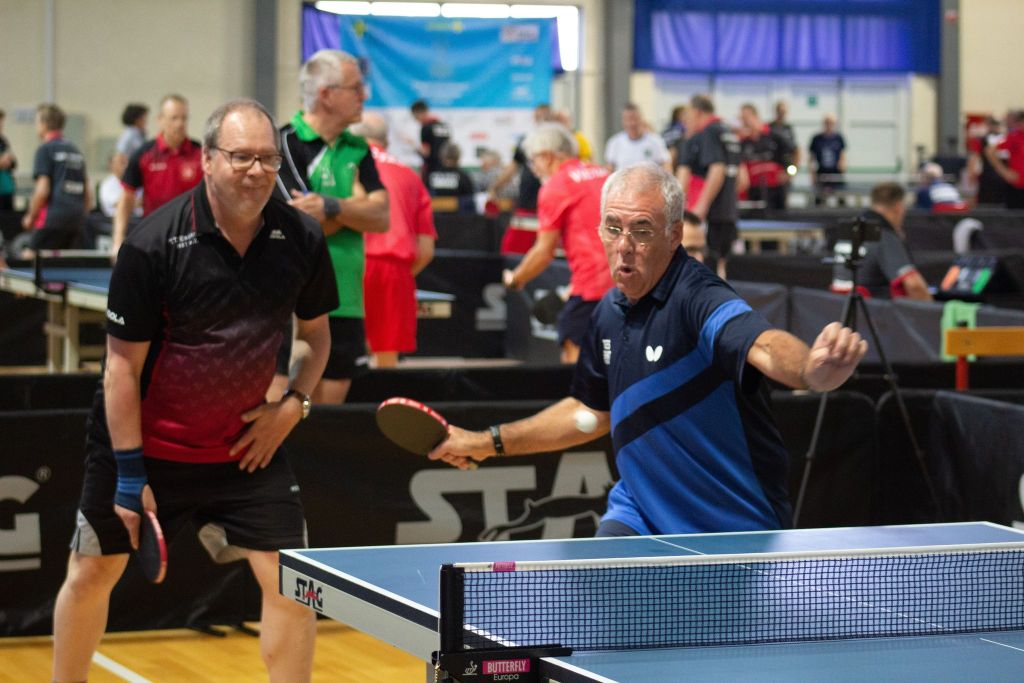
My Game Face (one of them) 😂 I spent 2 hours in the early afternoon as a volunteer umpire officiating 6 matches in the ladies doubles competition group stage. Challenging to say the least as some of the players were quite competitive (argumentative).
There were no official umpires provided by the organisers and we were relying on the goodwill of other players, supporters and coaches to umpire all matches.
Later in the afternoon Joy and I played in the mixed doubles consolation round but we were not able to progress.
Saturday October 13th Day 4
The men’s singles knockout competition started with all rounds up to quarter final taking place. The semi finals and finals were scheduled for Sunday morning. In the morning I played in the first knockout round of the men’s class 2 singles. I played against the current German Open Champion and we had a great 5 set match. I took the first 2 sets but he came back in the next two forcing a tense final set which I won to go through to the round of 16. The vocal support from the side lines was a big factor in getting me through this match.
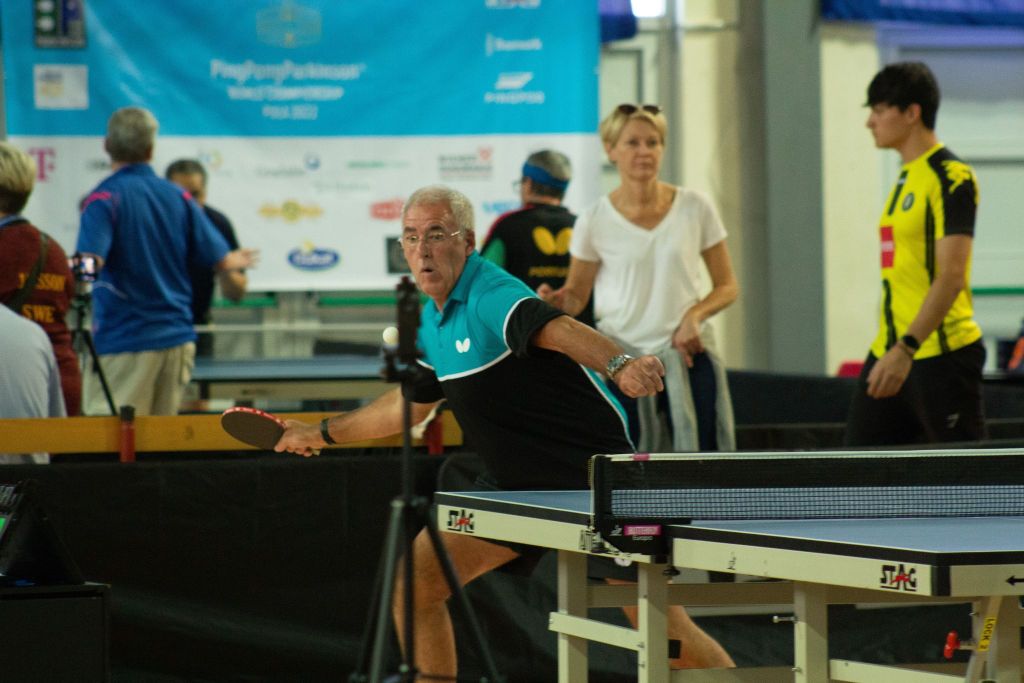
First knockout round with Jens Wanger Next I played against a French player who had won his group and went straight into this round along with some other group winners by-passing the previous round. An awkward player with bat rubbers that made it hard to read the ball and I narrowly won the first game after a deuce. The next two games were more comfortable for me as I adapted my game to counter his play and secure a 3- 0 win. I also got some sound coaching advice from one of the UK players after the first set. Thanks to John Hughes for that.
Topspin! (sometimes I do listen to the coaches 👍) Thirty minutes later I played in the quarter final against a Danish player. He was very experienced and very fast. The first game was very tight but he won it. He seemed to move up a gear in the next two games and I was unable to stay with him in both games ending up with a 0-3 result. The end of my singles competition.
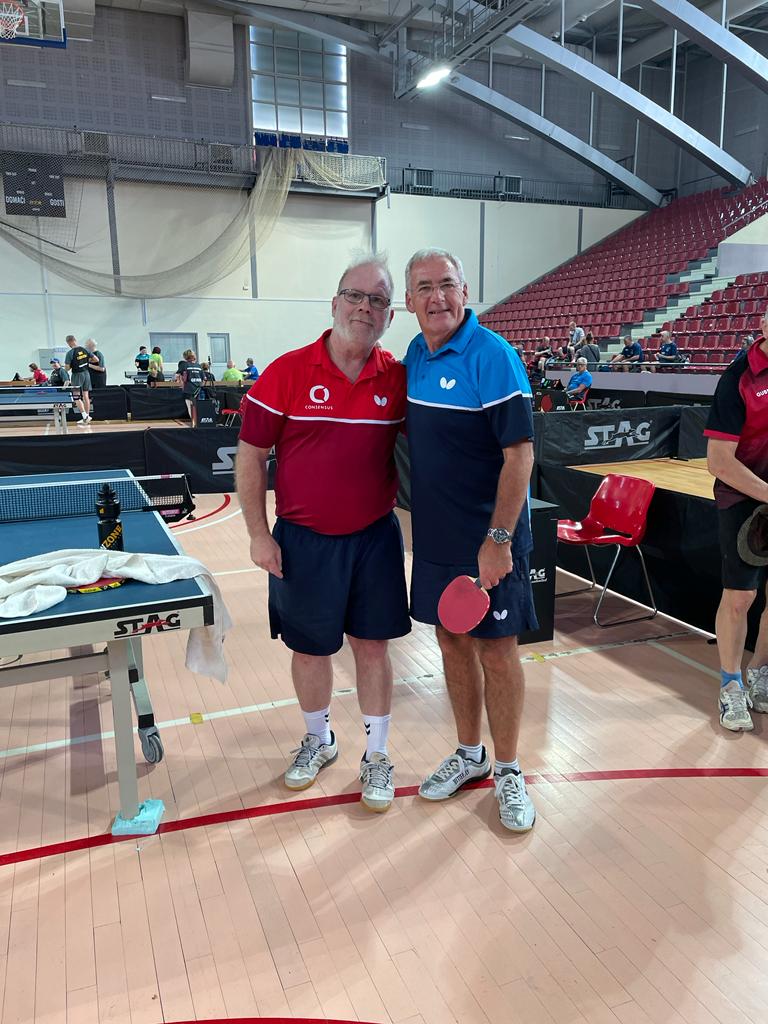
Michael Jensen who I lost to in the Quarter Final Overall very pleased with my performance in the singles and reaching the quarter finals, last eight in Class 2 of the Parkinson’s World Championships.
Later in the afternoon Christoph Freyberg and I played in the consolation doubles but could not progress any further. Once again it was an absolute pleasure to play with Christoph and experience his enthusiasm and positive attitude, despite his Parkinson’s and other medical issues that he has to deal with. A true friend.
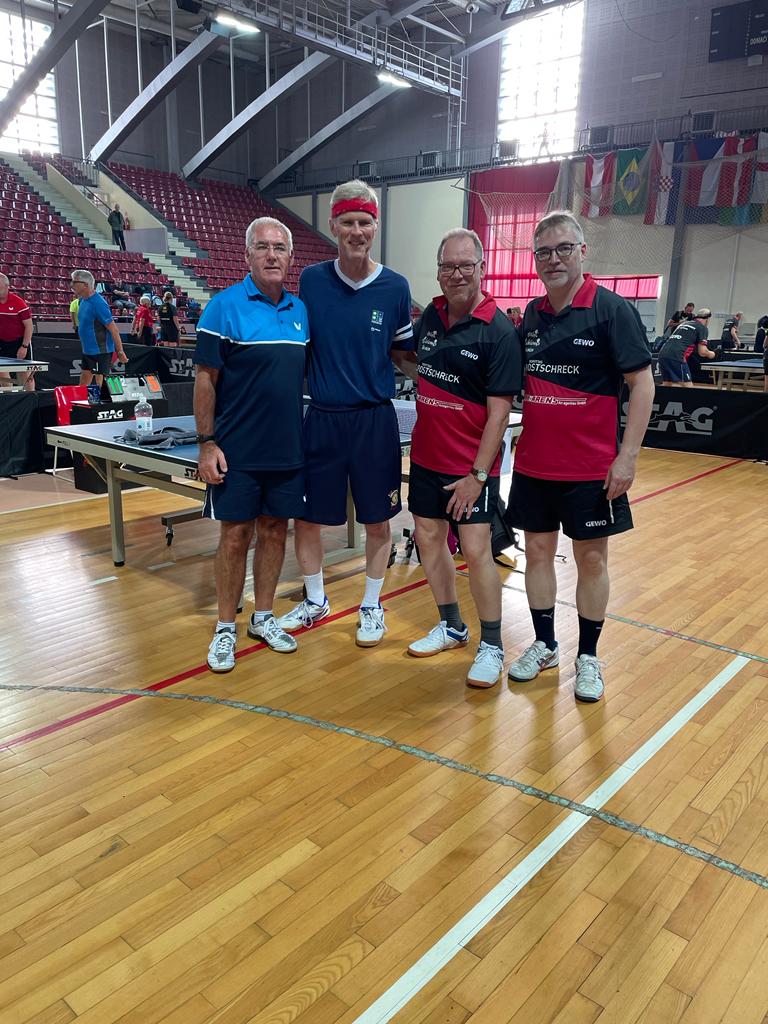
With Christoph and Scott – USA and Martin – Germany This ended my participation as a player in this years championships.
We had a social event scheduled for Saturday evening but due to poor planning / technical difficulties, this was cancelled at the last minute when we were already at the venue. As the venue was a bit remote we remained there for the evening and a few drinks with those already there.
Sunday 16th October Day 5
Although not playing I arrived early and helped some players who were scheduled to play in matches to warm up on the practice tables, doing drills, playing points, blocking etc, whatever was needed.
I then settled in to watch the semi finals and finals. I seen some great play and probably missed more, as all tables were in use constantly and there were just too many simultaneous games to keep up.
I watched a great 5 set match in the ladies doubles consolation final, won by Joy Paul and Margie Alley after a few deuces in the final set.
I also umpired the men’s singles class 2 final between Torbjorn Lidstrom (SWE) and Bjarne Taekker (DEN). Two great players I have come to know and respect at recent competitions and events. Congratulations to Bjarne who won the final.
Then on to the medal ceremony which concluded very quickly as there was an island trip planned for early afternoon for all players and there was a tight deadline.
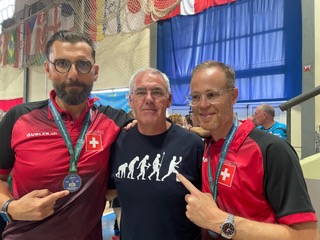
Congratulating Kurt and Carlo from Switzerland on their medal success The atmosphere, positivity and friendship around this whole event has been superb and I will miss it and all these fantastic people when it is over.
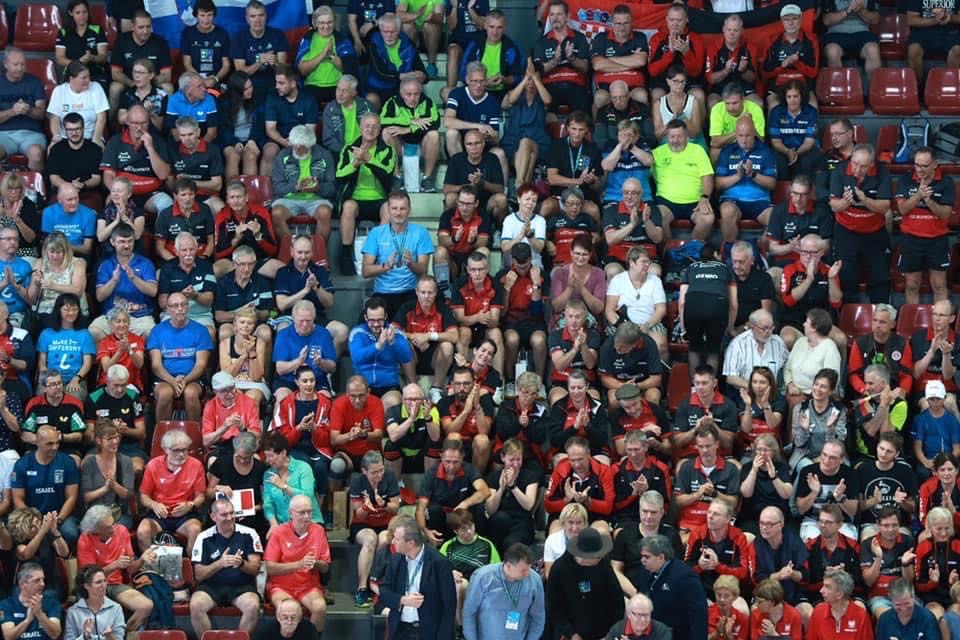
Everyone together What a way to finish off my sporting year. Or is it finished? Watch this space!
This left us with Sunday afternoon and all day Monday to sightsee and relax which is exactly what we did enjoying the down time after a hectic week.
Parkinson’s Impact
I have mentioned previously the challenge of managing medication and “off” times to be as ready as possible when matches are scheduled. This was the same as always but it certainly helped that in this event days were split into segments making the timing of matches more accurate enabling adjustment of timing and doses of medication easier to plan and execute.
However there still remained the long periods of downtime followed by short bursts of activity to play matches. Taking Parkinson’s out of the equation (wouldn’t that be great) we still have to deal with the aches and pains and injuries that come with playing sport and in my case getting older! It is difficult to keep prepared through this type of competition over 5 days but we do the best we can.
I had some interesting discussions with other PWP on whether vigorous exercise changes the efficacy of Parkinson’s medication. Some say they experience no impact others say exercising appears to cause the medication to wear off much quicker. It appears there are various impacts depending on the individual, which reflects the general variations each individual experiences in terms of Parkinson’s symptoms and their effects. However this is a very short term issue for those who experience it, what is not in doubt is the long term positive benefit of regular varied exercise for PWP.

It should always be fun What is the future for Parkinson’s Table Tennis – Ping Pong Parkinson’s (PPP) and the International Table Tennis Federation (ITTF)
In the weeks and months prior to this event there has been a rift between PPP and ITTF. For many months we did not know if the ITTF would be involved in the event and eventually it was decided this would be a PPP only event. I am sure many of the participants were unaware of this going on in the background and like me just want to play table tennis with this fantastic Parkinson’s community.
A few days ago, during the current event, the ITTF announced the next Parkinson’s Table Tennis World Championships would take place in November 2023 in Crete, and it would be an ITTF event. I question the timing of this announcement during a Parkinson’s World Championship that the ITTF are not involved in. This appears typical of the criticism between these two organisations seen recently in correspondence and statements from both sides.
I have only recently been on the periphery of some of these statements and correspondence and do not pretend to understand the full list of issues and motivations causing this conflict between PPP and the ITTF. This has been going on since the first PPP world championship was held in 2019 in New York.
However I will pose a question to both organisations PPP and ITTF:
You both have made many statements about your commitment to table tennis for People With Parkinson’s, citing the positive impact on the players participating, including physical, mental and social benefits that help us in dealing and living with our condition. If you truly stand by these statements and are committed to continuing with TT for PWP then your priority should be enabling this for our future and working with any organisation involved that shares this goal. Why can you not work together if you share this commitment to PWP?
What next?
For me personally a few days rest and downtime, get used to the cold weather in Scotland again and decide whether to proceed with an operation for my hernia. And of course get back to playing TT before the end of the week.
Long term my TT targets for 2023 include the next World Championships, the German Open, the Japsko Altea Training Camp, a potential UK Open in Birmingham. There are also competitions in Sweden, and possibly Denmark that may be options.
This is all in addition to my role as part of the Parkinson’s Table Tennis Scotland Association, which involves trying to help and support all the new TT sessions being started for PWP in Scotland, and get more PWP playing, to experience the positive benefits while having fun playing.
End
-
Parkinson’s National UK Table Tennis Championship
Parkinson’s National UK Table Tennis Championship 7 August 2022
This event was held at Drumchapel Table Tennis Club in Glasgow. This is the second time this competition has taken place, the first event was at St Neots in August 2021.
I have the privilege of being part of the Parkinson’s Table Tennis Scotland committee and as part of this group was heavily involved with organising this event. As you would expect this was not without challenges but hopefully we succeeded in delivering a memorable event enjoyed by all who took part.
Organising Team
Roy Claxton, Joy Paul, Leona Braund, Stuart Robb, Brian Carson
This event was sponsored and supported by:
Table Tennis Scotland
South Ayrshire Table Tennis Club
Drumchapel Table Tennis Club
Tees Sport
Funding Neuro
Asda
Thank you to all of the above and numerous volunteers across both days who collectively helped to make this event successful.
I add my own personal thanks to Tees Sport who are now sponsoring me as I continue my Parkinson’s Table Tennis development and participation in the various events planned in the months ahead.
This was also the first Parkinson’s competition held in Scotland and therefore provided a great opportunity for my wider family, friends, and fellow club players to attend and experience what I have been involved with for the last 12 months, and probably boring them to tears going on about it. Having this level of support added to the occasion for me personally and I am sure some of the those attending for the first time were amazed at the atmosphere, as well as the high level of table tennis being played.
Day 1 Saturday Practice Session
The event facility was opened for 4 hours for a practice session on Saturday afternoon. The was a popular session and gave players a chance to get some feel for the venue and surroundings where the competition was being held, and get some practice on the competition tables. Not all players were able to attend as some were still travelling.

A Busy Practice Day This was the first opportunity to catch up with friends from previous events and meet some new friends who were attending their first Parkinson’s competition.
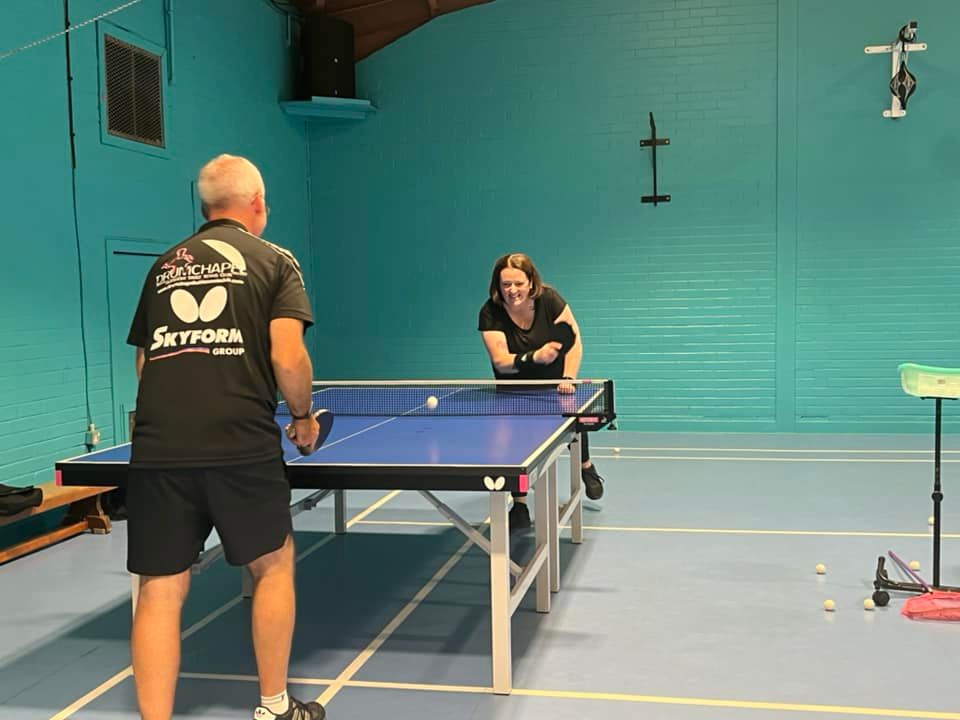
Practice with Karen I went to this session intending to play the part of host in my role on the organising team and help facilitate the session. However when the first player arrived and commented how great the venue looked and that he couldn’t wait to get some practice I was hooked and off I went to have a “hit” with George Chang. This was a treat for me to play with George, a great player and a gentlemen who I eventually played in the competition when we met in the semi final of the class 1 singles. Needless to say George won that match.
Me trying very hard to get a ball past George 😂 Social Event
On Saturday evening we met at a local social club and over drinks and food (always mindful there was a competition the next day), and continued to bond as a community. The value of this type of activity cannot be overstated as it provides an opportunity to catch up with old friends and meet new ones in a relaxed setting away from the excitement, stress (yes stress, for some) physical effort, medication “juggling” and everything else that comes with participating in competitive sport when you have a degenerative Neurological Condition.
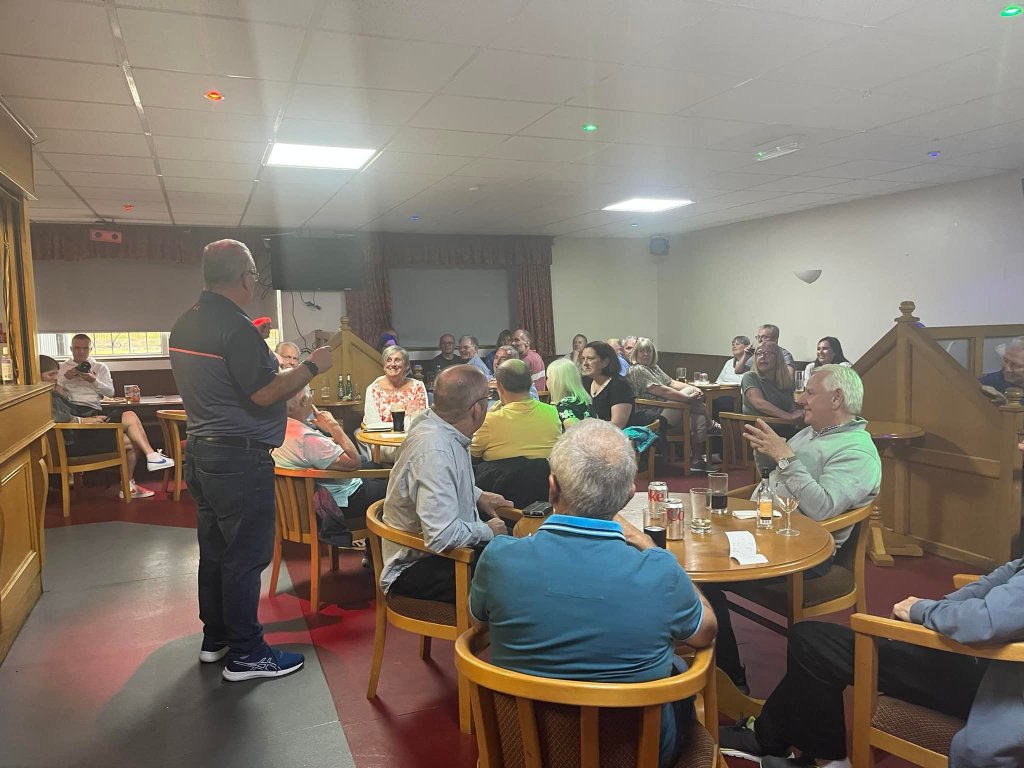
Terry making a “rare” Speech! (He is normally so quiet😉 ) At the end of the day we are all managing our Parkinson’s condition as best we can, while playing a sport we love that potentially delays progression of our symptoms, while trying to spread the wider message of the benefits of physical activity for People With Parkinson’s.
Audience after Terry’s speech, Terry delivers again Day 2 Competition Time
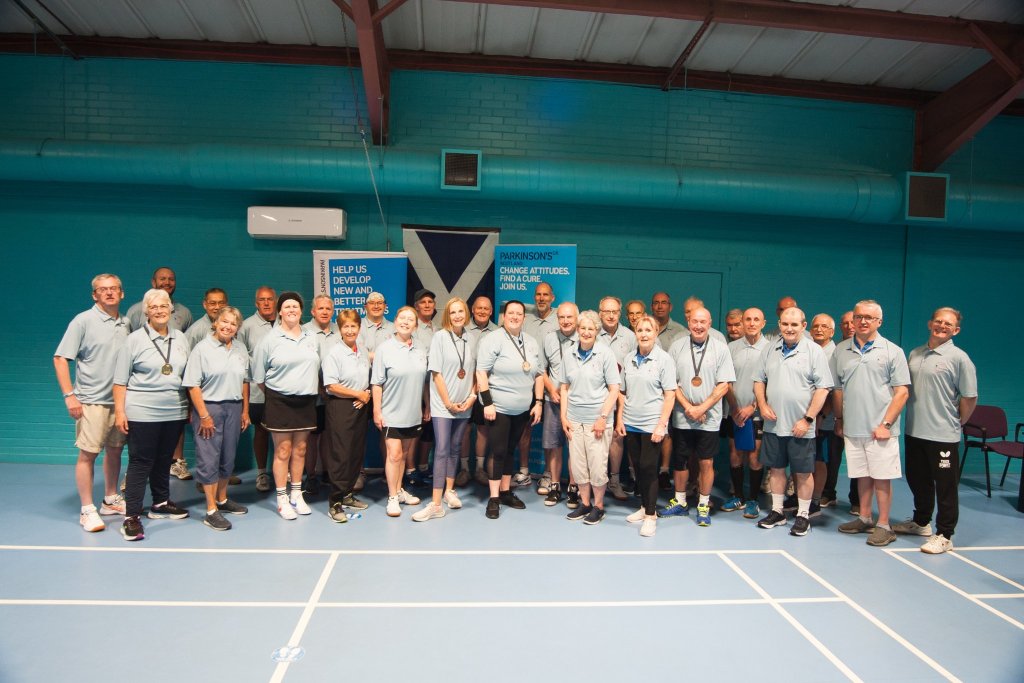
The Players Beginners Competition
We kicked off at 09:00 with the beginners competition. This was the first time this category was included in the competition and it was added to recognise the increase in numbers of players with Parkinson’s over this last year. It also provided a great opportunity to give these newcomers a taste of the competition environment, introduce them to the wider Table Tennis PWP community, and also recognise their commitment and progression. This hopefully demonstrates to other People With Parkinson’s what can be achieved.
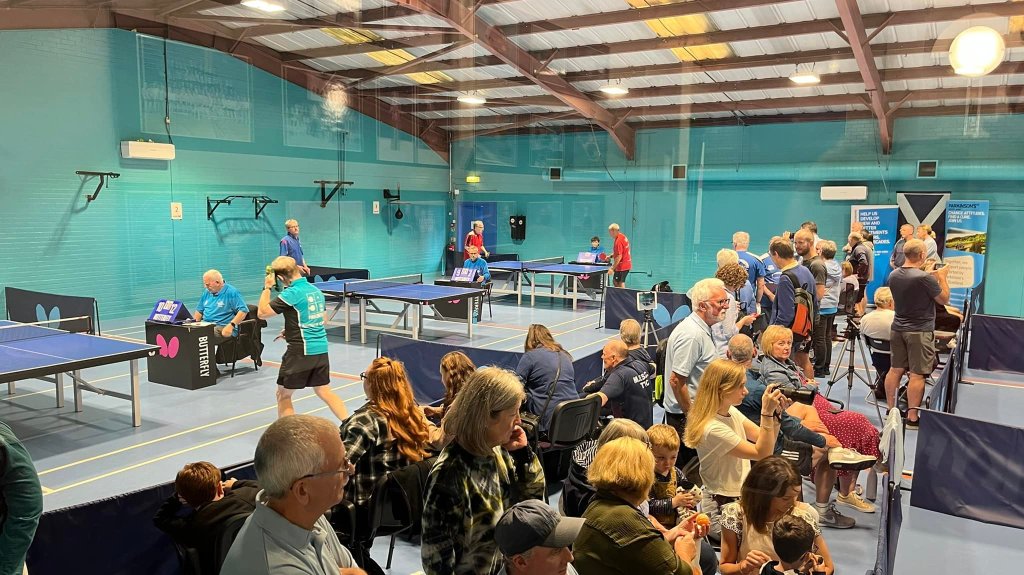
Incredible Spectator Numbers Those beginners who attend our Tuesday PWP TT sessions at Drumchapel which started in January this year, were all provided with a club shirt to wear during the competition which I am sure brought a sense of pride and belonging to them all. They not only looked like they belonged in the competition but they played like they belonged and I couldn’t be more proud of them all.
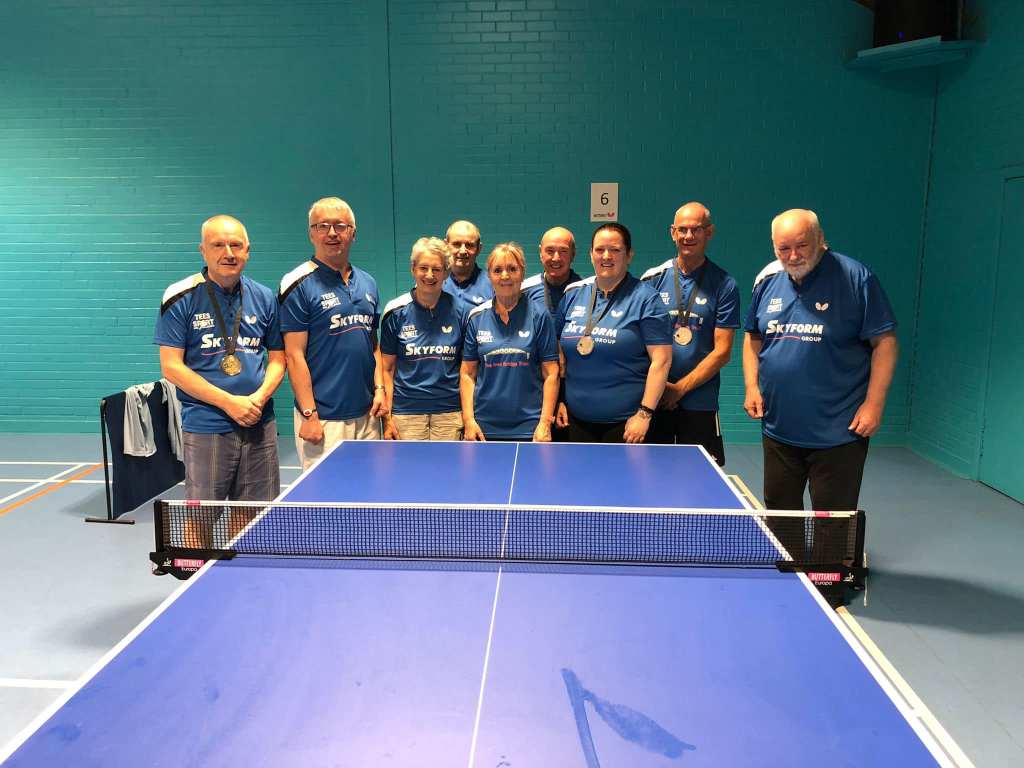
The Tuesday Club (ex Brian, I was in South Ayrshire TTC colours for this competition as this was the club where it all started for me). We were fortunate to have James Jopling, Director of Parkinson’s UK Scotland join us for the morning session. James presented the medals for the beginners categories and this added to the experience for those players. He also spent the morning engaging with numerous players, coaches and supporters, posting photographs on Twitter and enjoying the atmosphere of the occasion.

Ladies beginners, Karen, Pauline and Morag 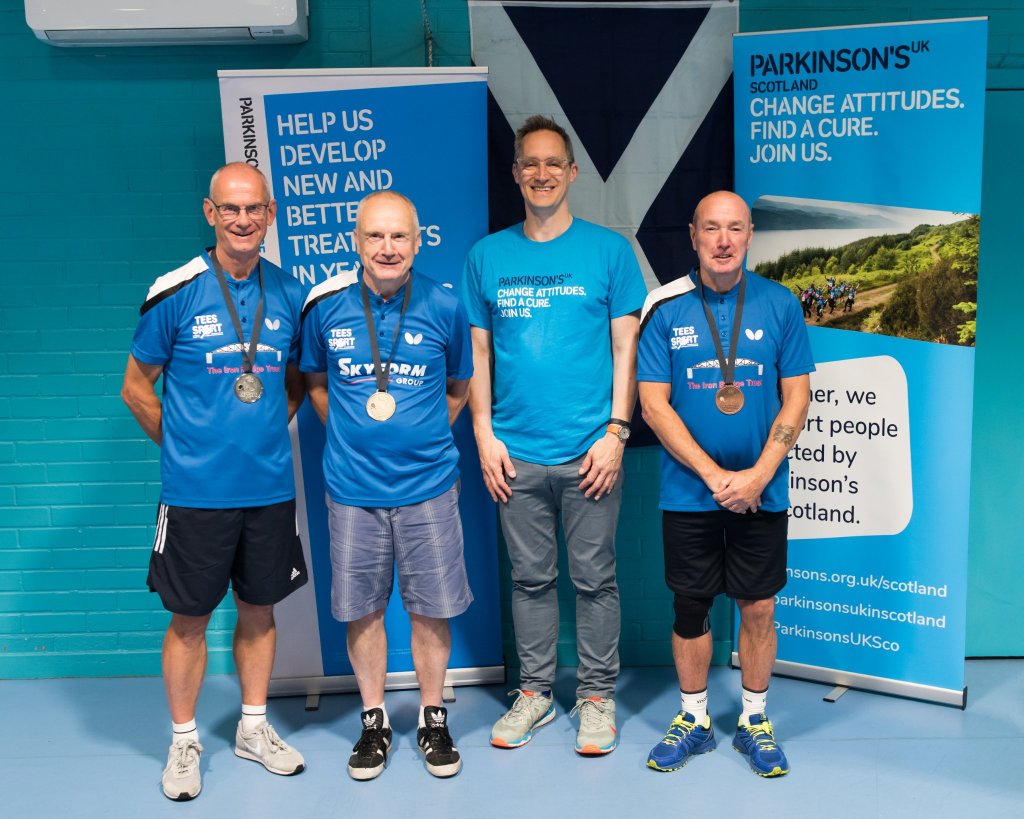
Men’s beginners David, Tam and Davie The Main Events
Next up was the men’s and ladies singles competitions.
We had both a Class 1 and a Class 2 men’s competition and a single Class ladies competition. All were hotly contested with some great matches some of which were very close.
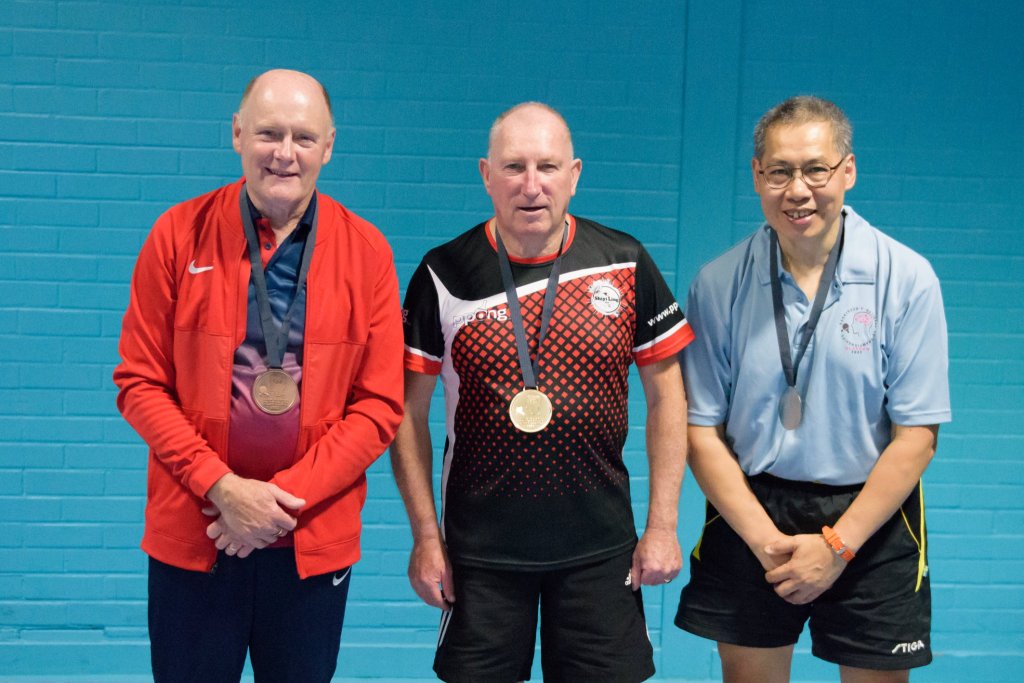
Class 1 Rob, John and George 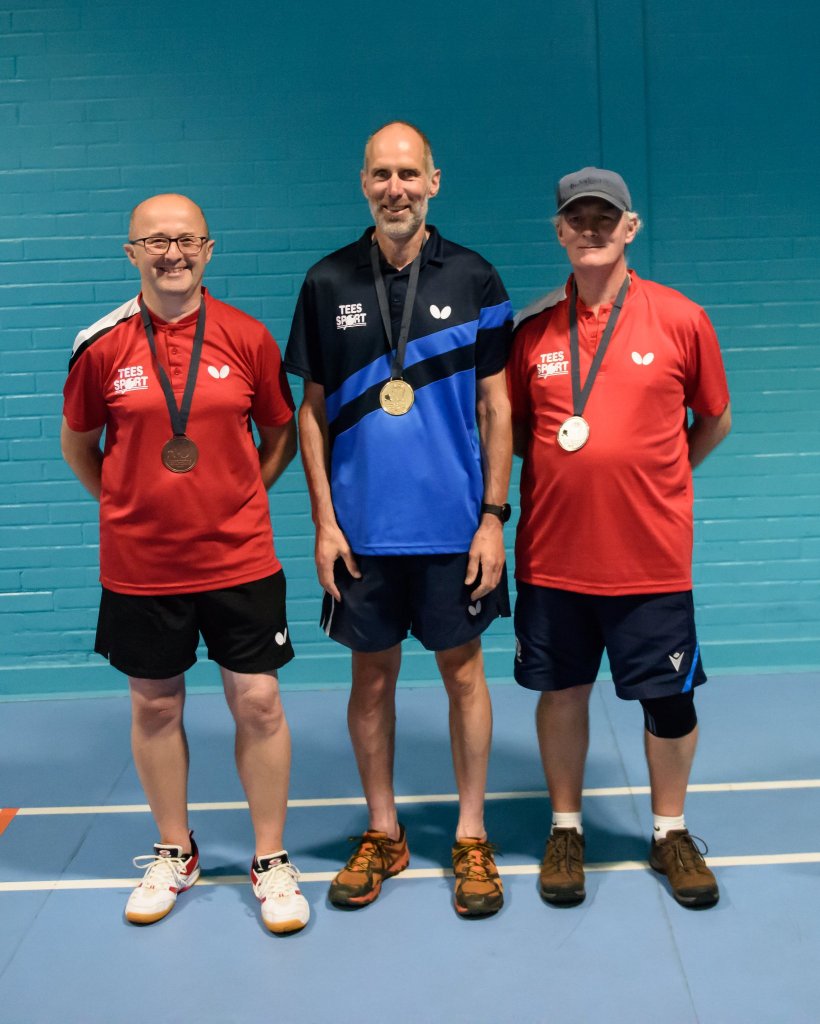
Class 2 Steve, Stuart and David 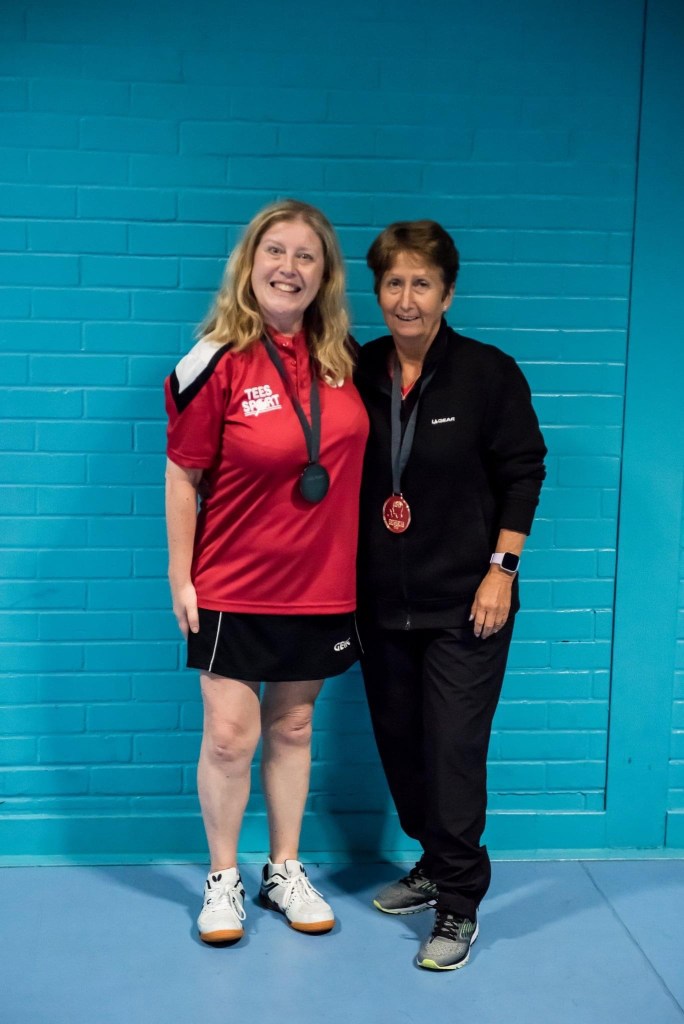
Joy and Jan (Jenny was unavailable) In parallel we also had the UK Open competition running which involved both male and female players from all categories (ex beginners). This was the first time this event had been held for PWP
This competition decided who was the UK Champion and many congratulations to Andy Cassy who was a worthy winner of this competition.
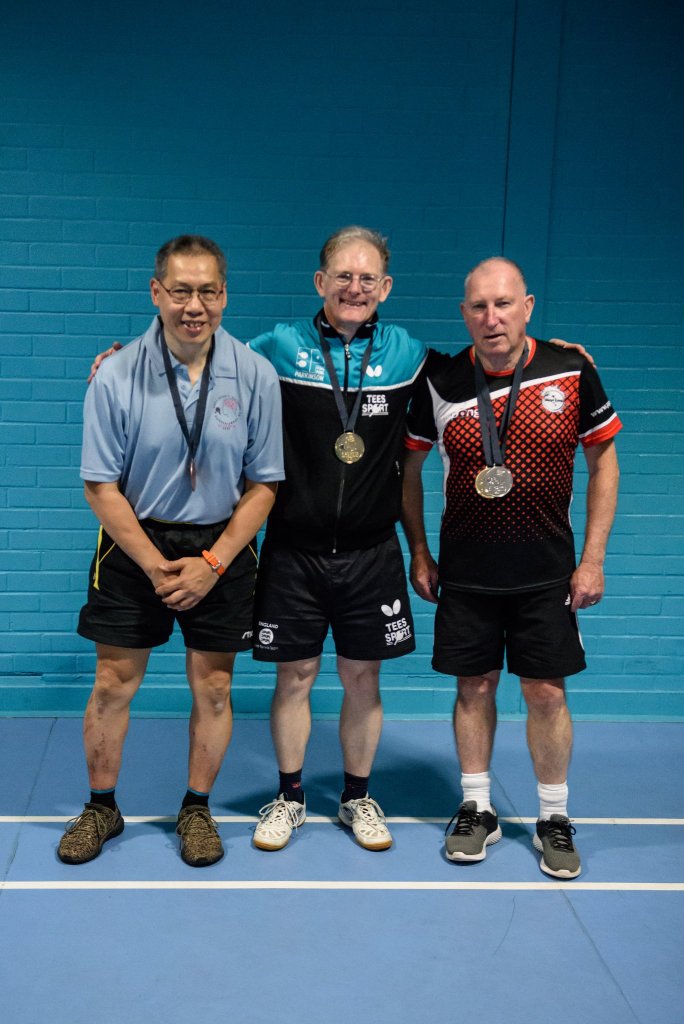
UK Open – George, Andy and John There is a full competition report published on the South Ayrshire Table Tennis Club Facebook page for anyone who is interested in seeing the final placing for all categories. Link below. (There are also many more photographs of the day at this link courtesy of Roy Claxton)
My Performance
I was entered in the men’s Class 1 and the UK Open. The classification system used this time although based on that used in previous competitions in Europe was “adjusted” slightly resulting in myself and a couple others being included in Class 1 (UK only) for the first time.
In the Class 1 competition I reached the semi final stage losing out to George Chan and ending up in fourth place after also losing the third place play off to Rob Dawson. This was after a difficult start losing my first group game to John Hughes who plays with anti-loop rubbers a new phenomenon to me which I struggled with, but another aspect of the game I need to learn to play against.
Brian trying to return a ball from John Hughes In the UK Open I reached the quarter final stage. Losing out to eventual winner Andy Cassy. The man with the lightning fast backhand.
What it feels like facing Andy Cassy across the net In my view a credible performance in both competitions alongside some very good players.
About Parkinson’s
Once again I, and am I am sure a number of others were “ adjusting” our Parkinson’s medication timings and doses to be at my “best state” when playing matches. This involves ensuring we are “on” when playing matches eg the medication is providing maximum benefit. I have explained in previous blogs the impact of “off” periods and what we do to manage these. Here are some details explaining why we do this.
Parkinson’s disease is caused by a loss of nerve cells in part of the brain called the substantia nigra. This leads to a reduction in a chemical called dopamine in the brain.
Dopamine plays a vital role in regulating the movement of the body. A reduction in dopamine is responsible for many of the symptoms of Parkinson’s disease.
Exactly what causes the loss of nerve cells is unclear. Most experts think that a combination of genetic and environmental factors is responsible.
The 3 main symptoms of Parkinson’s disease are:
- involuntary shaking of particular parts of the body
- slow movement
- stiff and inflexible muscles
A person with Parkinson’s disease can also experience a wide range of other physical and psychological symptoms.
To help manage the symptoms PWP take various medications in multiple combinations. The most used medication is Sinamet which is medication to replace the Dopamine we are not producing.
Sinamet has been around since the sixties and was probably the last major breakthrough in research into Parkinson’s.
Sinamet is converted into dopamine in the brain and stored in nerve cells to replace depleted dopamine. It can be combined with another drug, carbidopa or benzerazide, which allows more Sinamet to get to the brain and reduces side effects.
Another option used by many are Dopamine Agonists. These “mimic” or imitate the action of dopamine. A large number of PWP use a combination of both Dopamine and Dopamine Agonists.
There are also a number of other drugs available that enhance the effect of dopamine by preventing its breakdown before it reaches the brain.
As you can see above the medication regime is varied and can be complicated. For many PWP it involves different doses of different medications being taken at various times in the day which can be challenging for some. Add in the complication of trying to adjust timing and dose to be at your best state for a match during a competition and the possibility of error is very real. In extreme cases some individuals will “adjust” dose and timings in the days before a competition to get the best effect on the day
Summary.
Once again the Parkinson’s TT community have assembled and had a fantastic time with friends new and old. The atmosphere is always positive at these events no matter where they are held. Yes we all share a terrible disease but we also like to play table tennis, enjoy the benefits this physical activity provides and have fun together. The standard of play at this event was very high with a lot of very close matches. I include the beginners in this statement and considering most of them have only been playing for six months the level achieved is outstanding. This was a very long day in particular for those who reached final stages of the main competitions. Special thanks to the beginners who stayed around all day, helping out and soaking up the atmosphere even though their competition was concluded mid morning. I personally can’t wait for the next UK event.
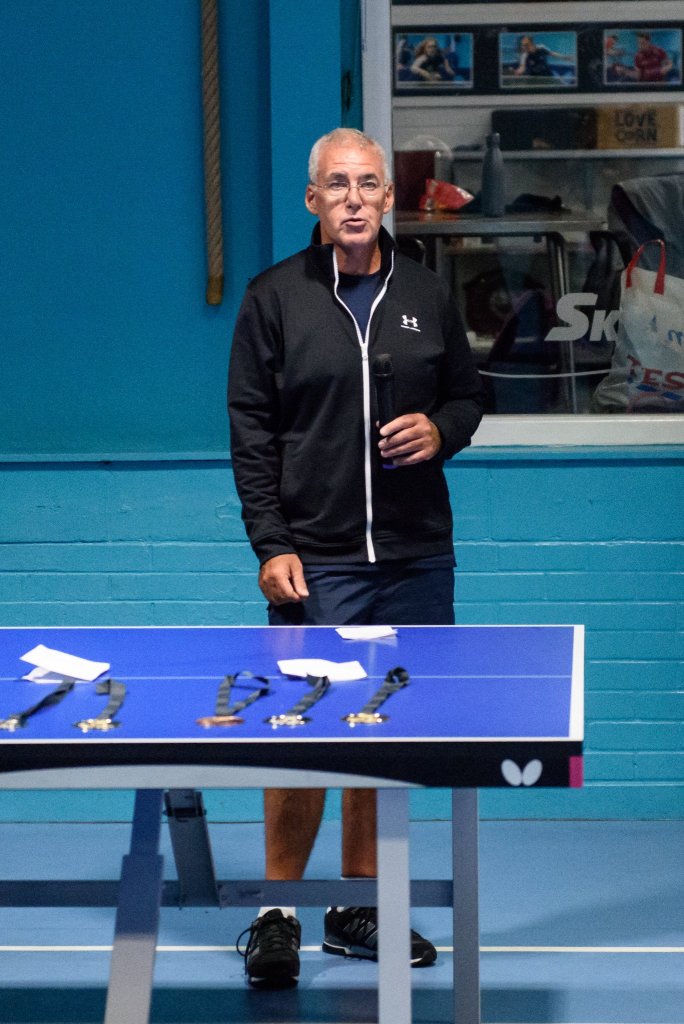
Brian delivering Closing Remarks on behalf of the Organising Team Closing remarks being well received. 😂 What Next?
The lead up to the competition was busy and at times stressful as we strived to deliver the best experience possible for all involved. Credit to Roy Claxton for stating to the organisation team on the eve of the competition, that on competition day we were players not organisers, and that should be our focus to maximise our level of play and enjoyment of the day. Easier said than done but thanks Roy. After some very short down time I will turn my focus to the next competition which is the Parkinson’s World Table Tennis Championships being held in Croatia in October this year.
A personal thank you from me.
I would also like to acknowledge a few people who have supported me personally in their various Table Tennis Clubs over the last 12 months as I got hooked on this fantastic sport.
South Ayrshire Table Tennis Club – Roy Claxton and John White
Drumchapel Table Tennis Club – Terry McLernon MBE, Charlie Brown, and the late Tommy McFadden
Knightswood Table Tennis Club – Neil Doherty
These individuals have spent countless hours coaching and advising me as I have developed my game this past year. They all share the same enthusiasm for the game and must sometimes wonder what drives me as I continually turn up wanting to play and learn and develop my game. I am convinced they all have the occasional moment when they think, oh no not him again? 😂
Coaches when they find out I am on the way to training End
Brian Carson
-
Parkinson’s German Open Table Tennis Championships (27 – 29 May)
This competition for people with Parkinson’s (PWP) took place in Bad Homburg in Germany between 27 and 29 May. This was the second time the event has taken place, the first iteration was held at Nordhorn in September 2021.
I was fortunate in being part of a small group of UK players participating this year and this blog is a short account of my experience. At the end I have included some medical testament explaining why People with Parkinson’s need to be active.
The UK players were, myself and Joy Paul from Scotland and Andrew Cassy and Liz Houghton from England
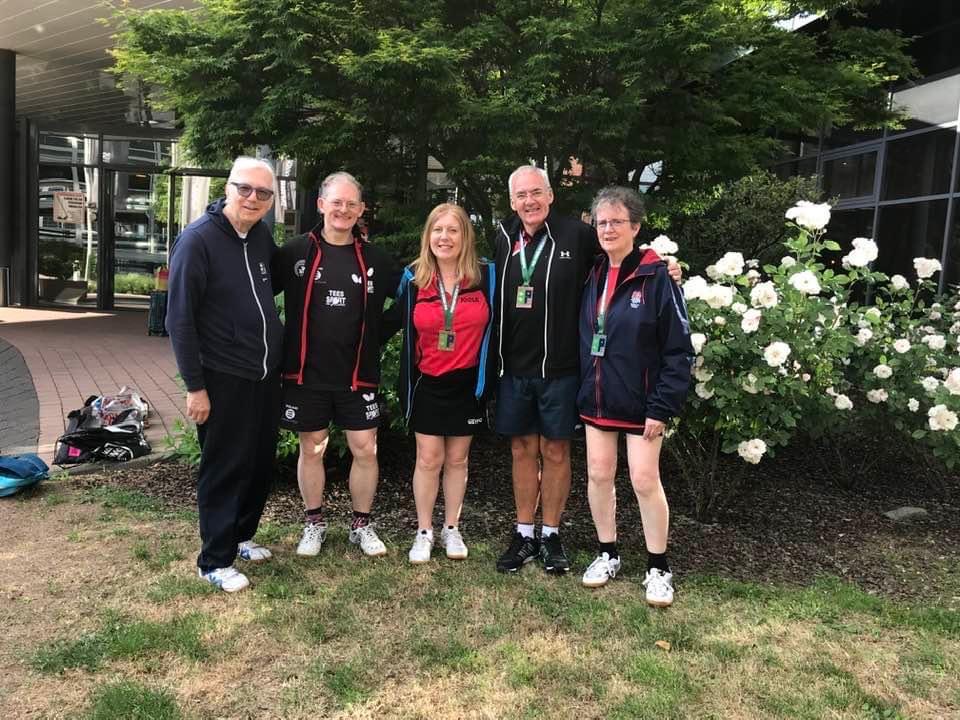
UK players with Nenad Bach, founder of Ping Pong Parkinson’s The event had 139 players taking part from 14 countries.
Travel
I was very fortunate to be travelling with fellow Scot and friend Joy Paul on this trip. I have mentioned previously the anxiety of air travel for PWP and my experience traveling alone. Having a companion for this journey made such a difference and removed a lot of the stress I felt previously. Our travel Into Frankfurt was uneventful and we arrived in Bad Homburg with no difficulty in the late afternoon.It was great to get settled and over drinks and dinner catch up with old and new friends as the players continued to arrive and the atmosphere began to build towards the competition.
Day 2We spent the morning walking the 5k into the centre of Bad Homburg and it was worth the effort to see at least part of this picturesque town. If our trip was a bit longer we would have included a trip to Frankfurt but this a not possible this time.
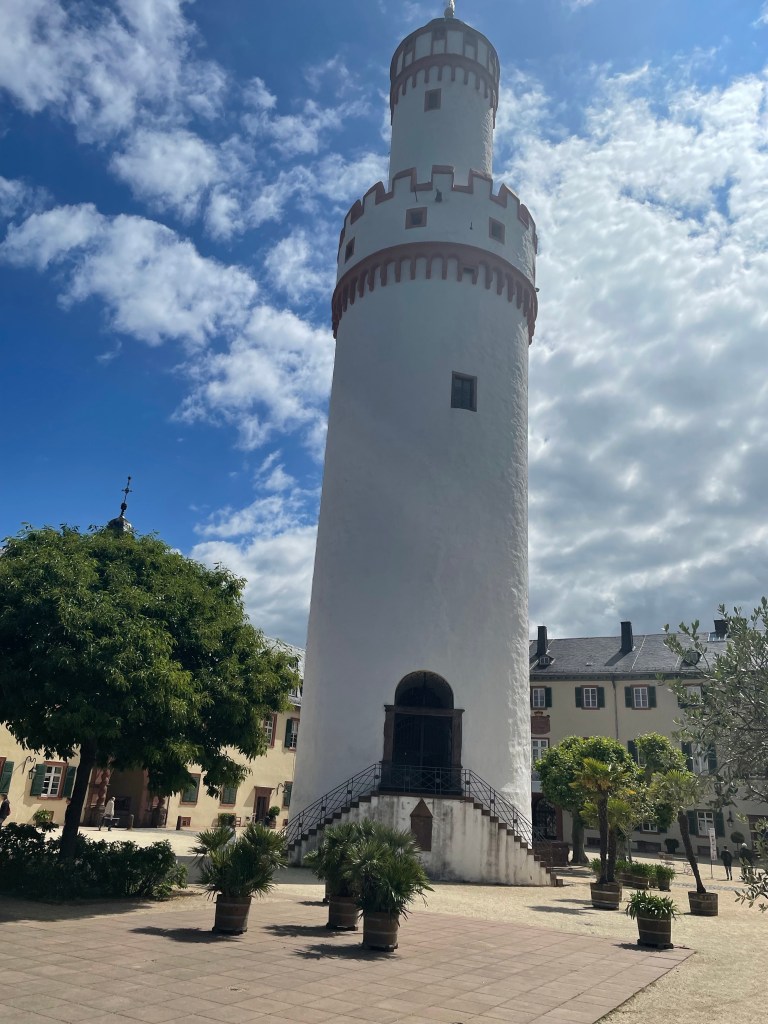
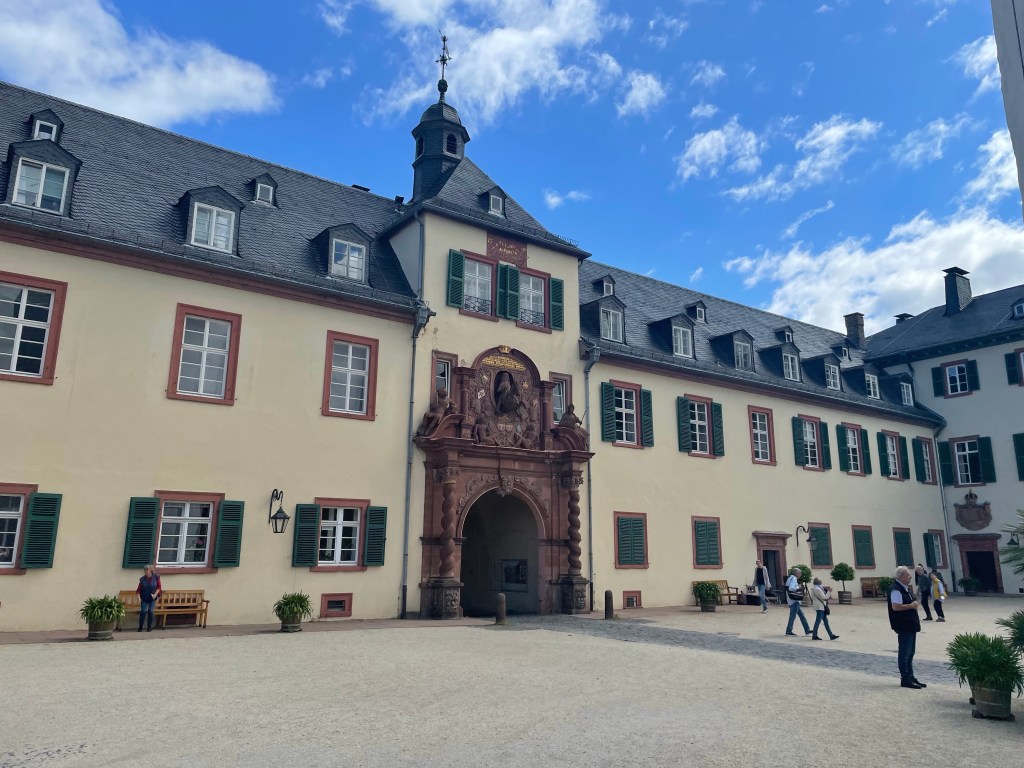
A small part of Bad Homburg we managed to see Early afternoon the organisers had a Parkinson’s “marketplace event” where various research and manufacturing bodies displayed their latest work and demonstrated progress in these areas. There were a number of exercise aids for PWP available to try out some TT related some not. An interesting session and again an opportunity for the gathered community to mix and catch up.
The day concluded with the opening ceremony followed by a buffet. At this event we heard from some local dignitaries and their commitment to the event and to supporting Parkinson’s causes. The formal part of the ceremony concluded with a brief by the tournament director on the format of the various singles and doubles competitions.
For the singles we were playing the Swiss format which was new to me and I took a while to fully understand this system. Round one involved playing 6 matches. After each match scores were reviewed to select the next opponent. Players who won their first match were paired together in match 2, players who won their first two matches were paired together in match 3 and so on. On completion players were listed in table format in order of results. The top 16 players progressed to a knockout phase, In parallel the remaining players played a consolation competition in the same format.
Consolation Rounds
Consolation rounds are a great feature of Parkinson’s competitions as they keep everyone playing and involved as long as possible. The event is about fun, networking, and social interaction as well as being a competition. Without this format it would be a less attractive event to participants some of whom have travelled far and at significant personal expense. Without consolation rounds some players would be eliminated from a three day competition in the first few hours of play on the first day.
Competition Timetable
The competition was held over three full days. There was much thought put into the timetable by the organisers to try and give players 6 hour time slots each day when their matches would be played. This prevented players (remember they are all PWP) from needing to be in the arena from first thing in the morning to well into the evening. The organisers should be commended for this and for the overall organisation and execution of the event which was first class.
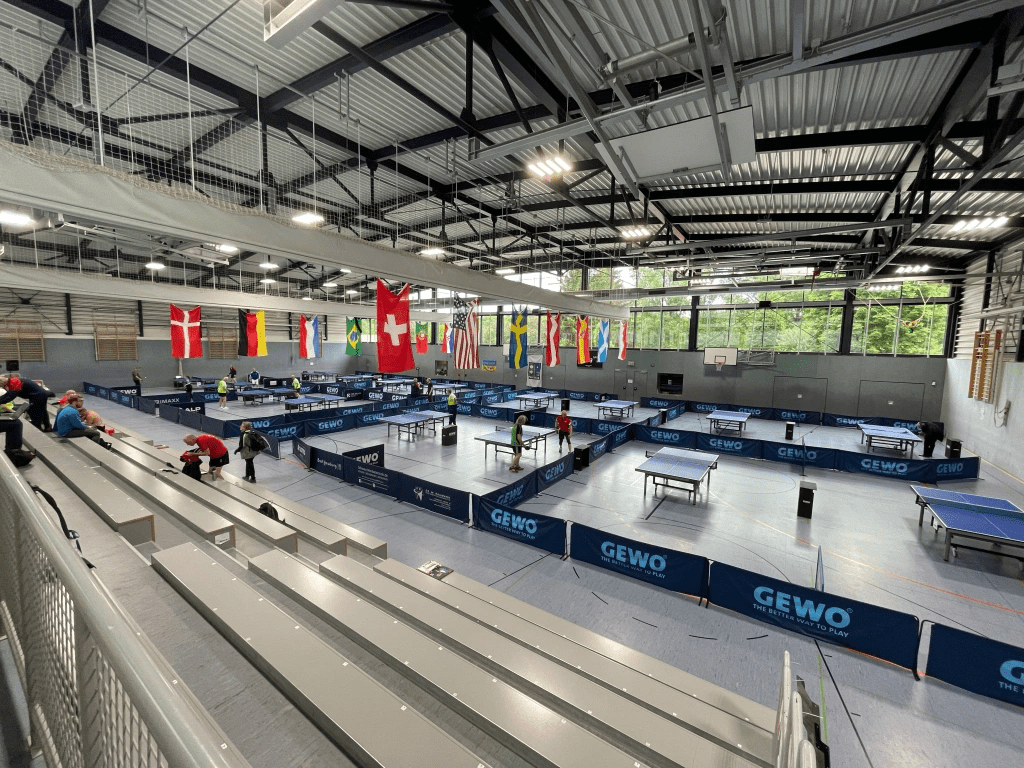
Competition Venue This is how the competition looked for me in terms of matches over the three days
Friday am – 6 singles matches
Saturday am – 3 mixed doubles matches
Saturday lunchtime – 3 men’s doubles matches
Saturday early afternoon – singles round of 16 knockout match
Saturday late afternoon – singles quarter final
Sunday am – 2 men’s doubles consolation matches, 2 mixed doubles consolation matches
Sunday lunchtime – singles semi final match
A very busy and exhausting three days of competition but this was my choice as I elected to play in both doubles competitions as well as the singles. Not every player chooses to do this and for some who do elect to play in all three this is sometimes not possible as there are not enough female players for every male to play in mixed doubles.
All matches were played with great spirit and everyone was enjoying the experience.
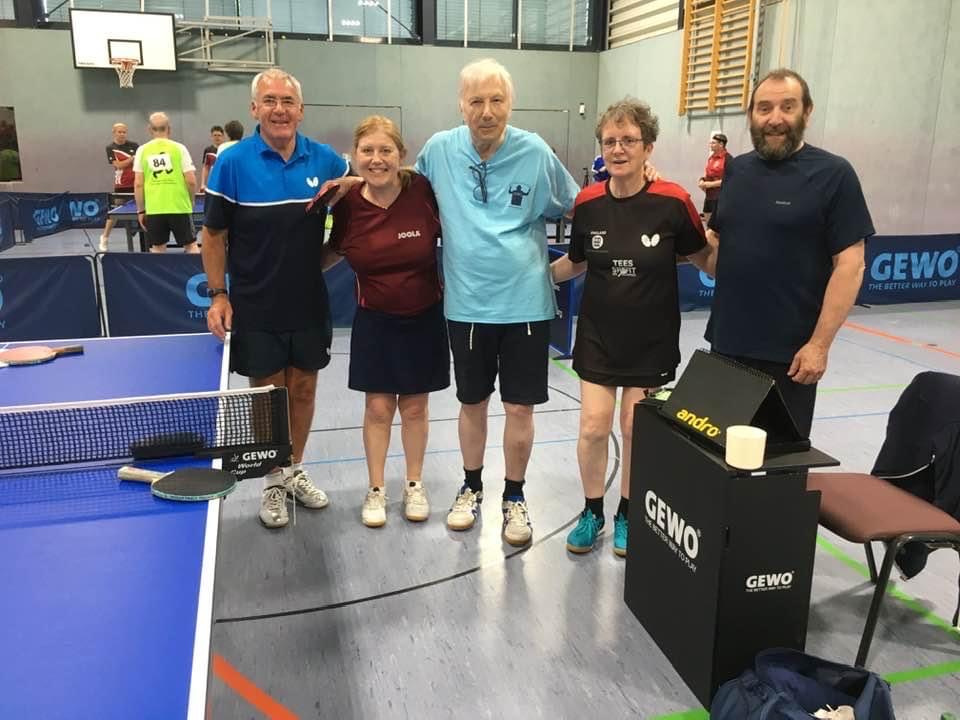
Mixed doubles group match with Joy, Nenad, Liz and Umpire Gerry Houghton 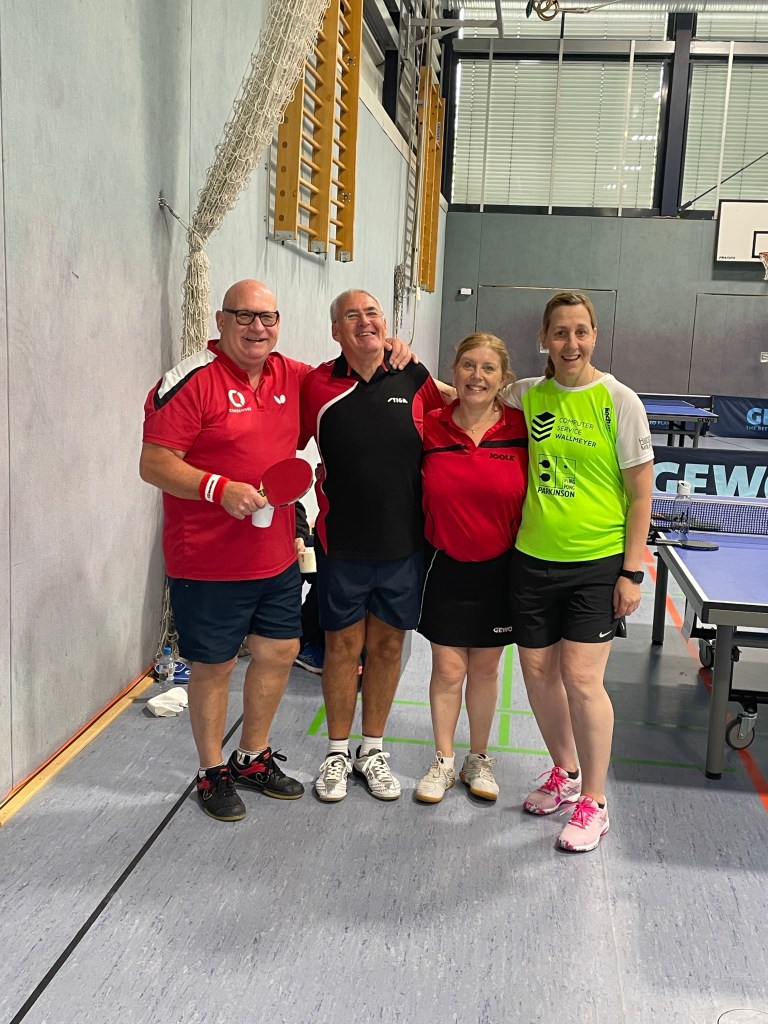
Mixed doubles consolation round with Jesper, Joy and Cecilia The above match was a fun experience from beginning to end as we are all friends and did not take it too seriously. Despite repeated requests from me (jokingly) to stop putting spin on the ball 😂Jesper continued to do so. At some points we just could not stop laughing and even the tournament referee was watching with a smile on his face.

Jesper taking no prisoners 
When I score a point against Jesper
Saturday Evening Event – This was dinner and drinks for all players, partners, families, officials etc at the hotel. This was another opportunity to spend time with old and new friends in a social environment where competition is forgotten and having an enjoyable experience with fellow PWP from various countries is the priority. There was some excellent entertainment provided by local school children that added to the relaxed atmosphere.Day 6 Monday – travelled home tired but very happy.

Me at Frankfurt Airport on Monday morning What was the outcome of this event?
In terms of performance for the UK players, both Joy Paul and I reached semi finals in our respective singles competitions and received bronze medals. Liz Houghton reached the final in the mixed doubles and received a silver medal.
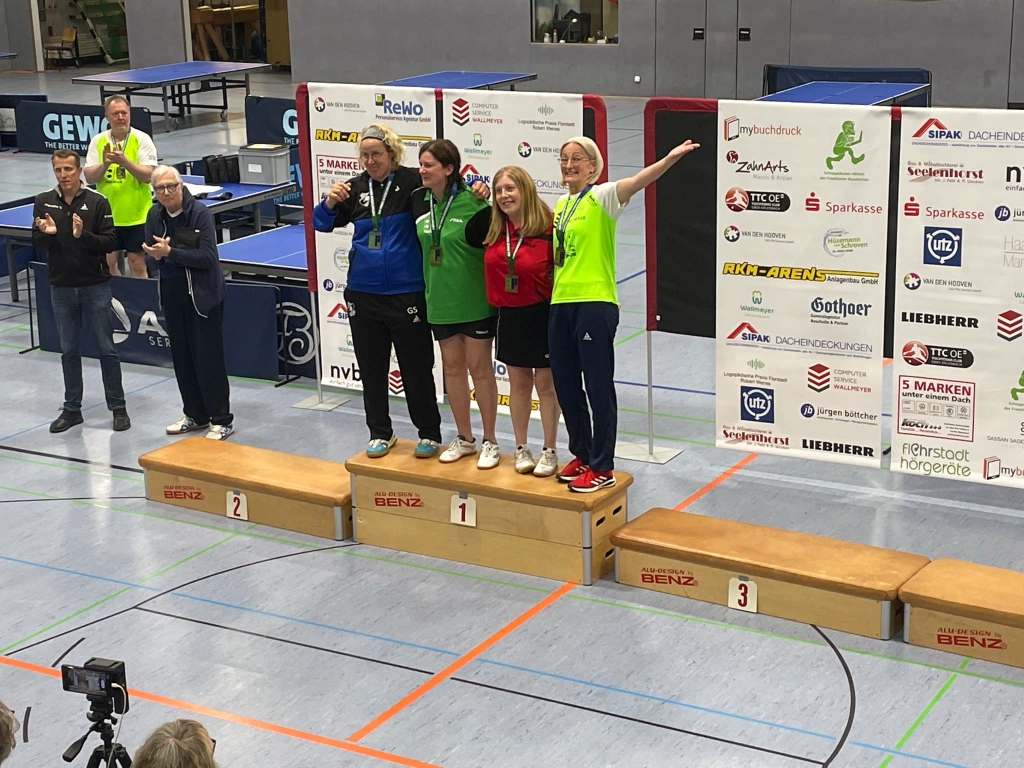
Joy Paul and the other Class 1 ladies singles medalists 
Brian Carson with the other Class 2 mens singles medalists More importantly we had a fantastic experience with a group of people all dealing with an incurable degenerative disease who, through their passion for table tennis and determination to live life to the full are an absolute joy to be with. They also inspire many others that physical activity is a major part of the treatment regime for this disease
Mental and physical benefits of exercise for People with Parkinson’s
PWP have everything to win if exercise works little to lose if it doesn’t. We now know that such inactivity only accelerates the progression of Parkinson’s
Predictably, the 2020 COVID Pandemic decreased physical activity for those living with Parkinson’s, translating into more physical and mental symptoms. Subsequent research showed that many experienced “worsened symptoms . . .slowness, stiffness/rigidity, tremor, gait, freezing of gait, speech, pain, sleep disorders, concentration, feeling stressed, anxiety–depression, constipation, and forgetfulness.”
Without exercise, Parkinson’s progresses even faster. Professor Bas Bloem, Medical Director and Neurologist at the Parkinson Center, Nijmegen, Netherlands, states that “The adverse effects of inactivity include cardiovascular disease, osteoporosis, insomnia, cognitive decline, depression, constipation, and all lead to early mortality. All of these are risk factors when you have Parkinson’s, so if you are both inactive and have Parkinson’s, your risk of early mortality is higher.”
Dr. Bloem goes on to say daily exercise is critical for those living with Parkinson’s because:
- Exercise helps your heart, brain, bone density, lungs, and more.
- Exercise may prevent Parkinson’s.
- If you have Parkinson’s, exercise works like a medication. It is continually proven by research that exercise suppresses symptoms of Parkinson’s.
- It is currently believed that if anything can slow the progression of Parkinson’s, it’s regular exercise.”
That is an important distinction to understand: Those living with Parkinson’s often become discouraged at less-than-hoped-for results from regular exercise. If they aren’t experiencing results, they are likely exercising at too low of an intensity level. Unfortunately, many quit exercising because they think it’s not working. They haven’t been taught how to exercise to get their desired results.
Yes we all enjoy the social and competitive aspects of these type of competitions and find then both stimulating and enjoyable, but as you can see from the information above exercise is medicine and is critical for PWP to maintain quality of life for as long as possible while we all wait and hope for a cure to be found.
Exercise is Medicine End
Brian Carson
-
Parkinson’s Walking Football (Glasgow)
Parkinson’s Walking Football, a blog by Brian Carson
29 April 2022
A slight change of topic for this blog. As mentioned previously I participate in various sports and exercise classes to help me manage my Parkinson’s Disease. In recent months I have been fortunate in being able to participate in a walking football programme designed specifically for People with Parkinson’s (PWP).
Background
Late last year Glasgow Life ran a pilot programme in partnership with Parkinson’s Active to determine the suitability of walking football for PWP.
The pilot ran from October through to December 2021 for 10 weeks and was based mainly in the indoor arena of the Toryglen Regional Football Centre in Glasgow.
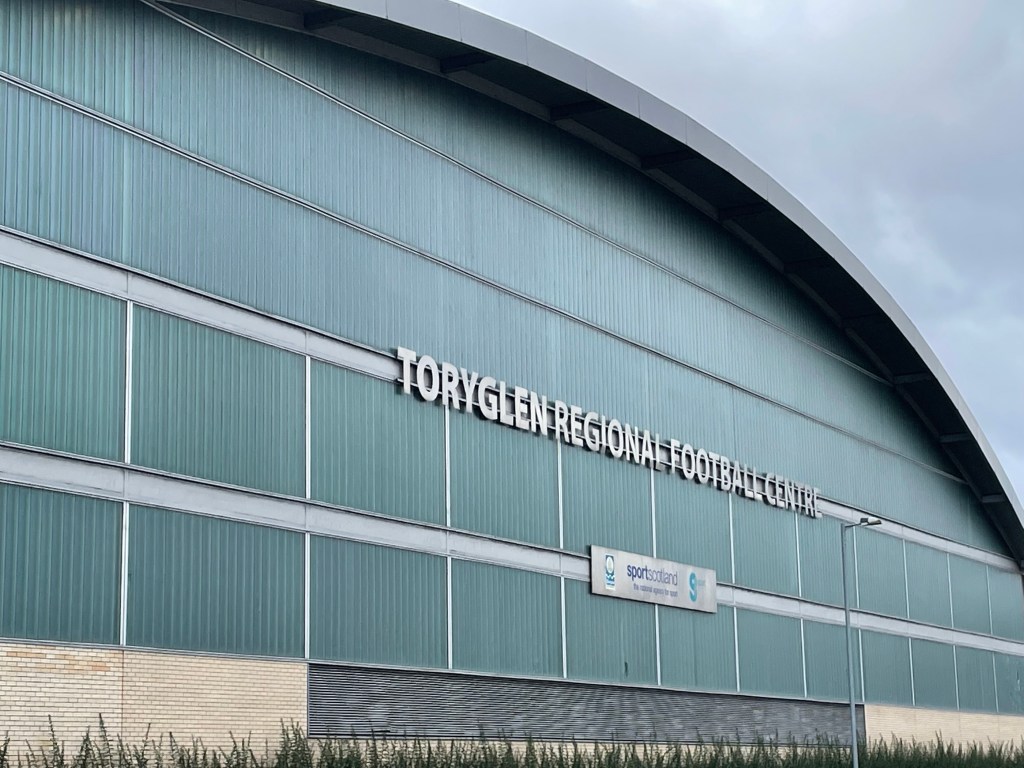
Parkinsons’s Walking Football Venue in Glasgow The first session was supported by volunteers from Pollok Utd who had become West of Scotland over 65’s champion the previous day.
From the outset the aim of Glasgow Life was to provide a safe and fun space for players to enjoy walking football. As a participant in the pilot I can personally confirm this was achieved and in my view exceeded.
The lead coach for this pilot undertook Parkinson’s UK Physical Activity and Exercise Training. This is a programme designed to inform coaches, trainers, activity providers etc, who deliver exercise and coaching to PWP, about Parkinson’s Disease, and what they need to know when coaching and leading activities
The pilot was supported by Specialist Physiotherapists who provided input to ensure the content was safe and focussed on the type of activity PWP need.
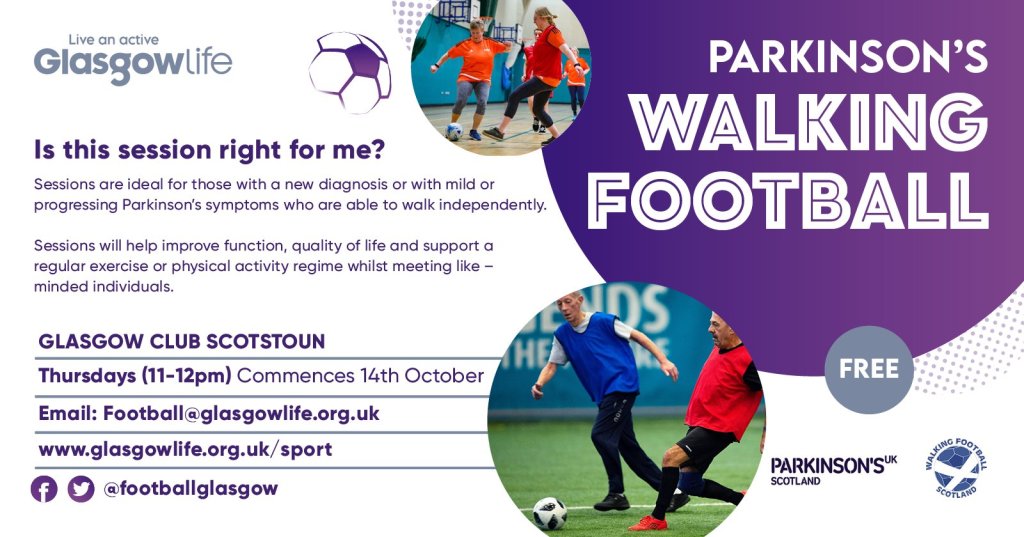
Flyer for the Pilot The Pilot
These sessions were attended by both male and female PWP and previous knowledge or experience of playing football was not a requirement to participate. This is still the case and the current participants are mixed in both gender and previous experience of playing football, in my view this adds to the experience.
At the beginning of the pilot each participant was given a sit to stand test and completed a wellbeing questionnaire. This was needed to set a baseline for each participant that could then be used at the end of the 10 weeks to assess progress against. The tests were repeated at the end of the pilot and the group demonstrated an overall improvement of 33% in sit to stand tests.
The activity did not just consist of turning up and playing walking football. It was an exercise session based around walking football but included many varied activities that worked on confidence, flexibility, team working, communication and cognitive engagement. This made the whole activity suitable for all participants irrespective of whether or not they had played football previously. or what movement restrictions they had as result of their Parkinson’s.
Throughout the pilot the coaches changed their approach considerably as the participants developed, adapting the exercise activities to challenge and stretch us always making sure we were comfortable and safe and most important, having fun.
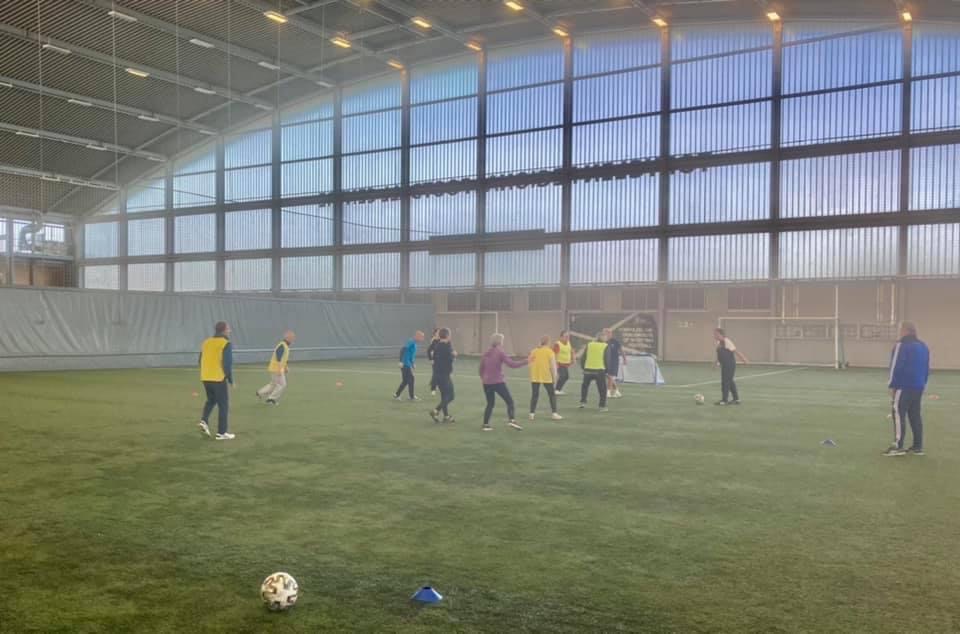
One of the early sessions Where Next?
The pilot was a great success in developing an exercise class based on walking football that proved to be very popular.
So popular in fact that a Parkinson’s session has now been included in the Glasgow Life weekly Walking Football programme.
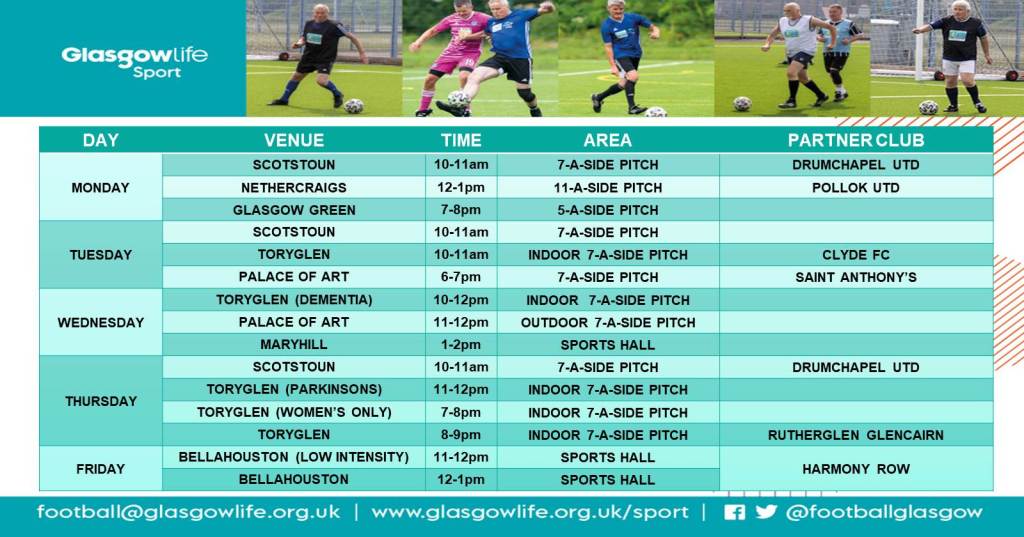
Glasgow Life Weekly Walking Football Schedule Why Me
As mentioned previously I have adopted the mantra “exercise is medicine” and consider exercise vital in helping me to manage my Parkinson’s Disease. I participate in many activities, get some similar and some different things from each one. I see the walking football sessions as a key part of my weekly activity routine.
What does a session look like?
Sessions are varied weekly to keep them fresh and challenge the group to continue to develop and improve. Yes we all have Parkinson’s, yes we all have a different mix of symptoms of varied severity, but the coaches know and understand this and have the knowledge and skills to stretch and develop us in a number of ways all the while keeping it safe and fun.
Sessions include a dynamic warm up, and then various drills passing and moving, cognitive dynamic exercises, team games including adapted netball as well as football, followed by a warm down and a social cuppa. We are encouraged to work as a team, be vocal (see below), support each other, be spacially aware, and anticipate and react to situations. I find these sessions invigorating and tiring and enjoy every minute.

Coaches preparing for a Parkinson’s Session Parkinson’s Symptoms
I have previously mentioned some PD non motor symptoms, depression, anxiety and apathy. One I have not mentioned before is reduction in voice volume, sometimes accompanied by reduction in voice clarity as control of facial muscles can be impacted, often referred to as masking, the medical term is hypomimia. I personally have had numerous sessions with a speech therapist who was a great help in providing support and through various exercises has improved my voice clarity and volume. This has subsequently improved my confidence back to where I was pre diagnosis. During my working life I would happily address large numbers of people without giving it a second thought. I lost the confidence to do this when Parkinson’s impacted my voice volume and clarity as I became very self conscious. However after speech therapy improved my speech I gave a short presentation to almost 90 health professionals and exercise providers at a Parkinson’s Active event over Zoom.
Some PWP participate in singing activities to help with voice volume and clarity and this can be very beneficial for both the voice and mood. Note: the ability to hold a tune is not a requirement for PD singing sessions, anyone can participate, although if you heard my singing there may be a special case made for excluding me for these type of sessions.
My preference instead to exercise my voice, in addition to continuing with the prescribed exercises privately, is to shout at my team mates during drills and games at walking football sessions, where we are encouraged to be vocal as part of the teamwork ethos that goes along with these activities. I can’t sing but I can shout at my maximum volume “MAN ON”, “WIDE RIGHT”, “RED BIBS WHERE ARE YOU” etc etc, and very occasionally “GOAL” and I do mean very occasionally. 😂
Who delivers these sessions
Lead Coach – Drew, runs the sessions, passionate about football keeps us smiling
Coach – Ricky, always thinking and expanding drills to push us harder and keep it fresh.
Coach – Russell, has a great football brain sometimes wasted on us 😂
Coach – Peter, the goalie and adhoc yoga 🧘♀️ instructor,
Coach – Jim, the Scottish Maradona
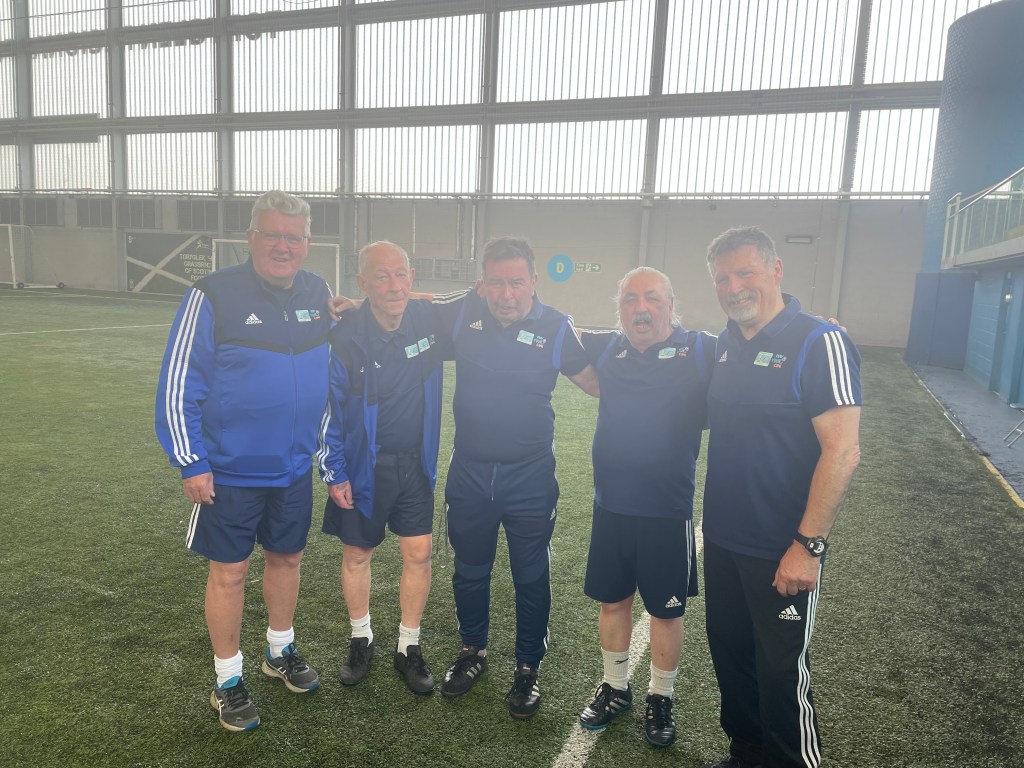
Coaches Drew, Russell, Ricky, Jim and Peter What have I got from the programme?
I get many things from participating in these sessions. Increased fitness and stamina, better balance and coordination, cognitive challenge, improved spacial awareness, encouragement to work as part of a team, and the confidence to make myself heard during games.
I used to run as part of my exercise regime before I was diagnosed with PD. As my condition developed, issues with my balance, my walking gait and more importantly my confidence caused me to give up running and take to walking and cycling instead.
As a direct result of this programme I have been running again, not great distances as before but the short sprints and movements that help me enjoy and be effective during these activities.
I participated in a Dementia Walking Football Festival in November to support this great cause.
I was also invited to play for Glasgow Life during a Football Glasgow Festival of Football in December.
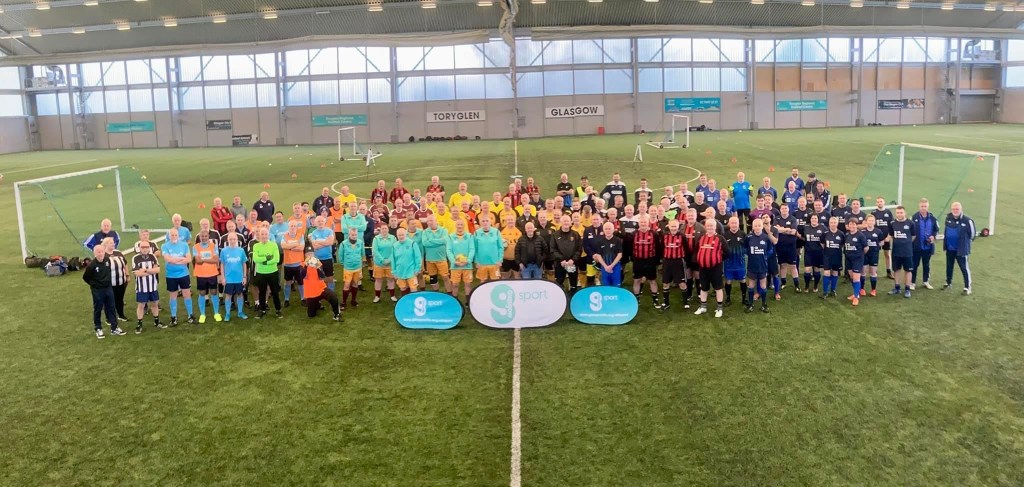
14 Teams from across the country took part in the December Festival If you had told me three months before I would be involved so actively in these sessions I would have scoffed.
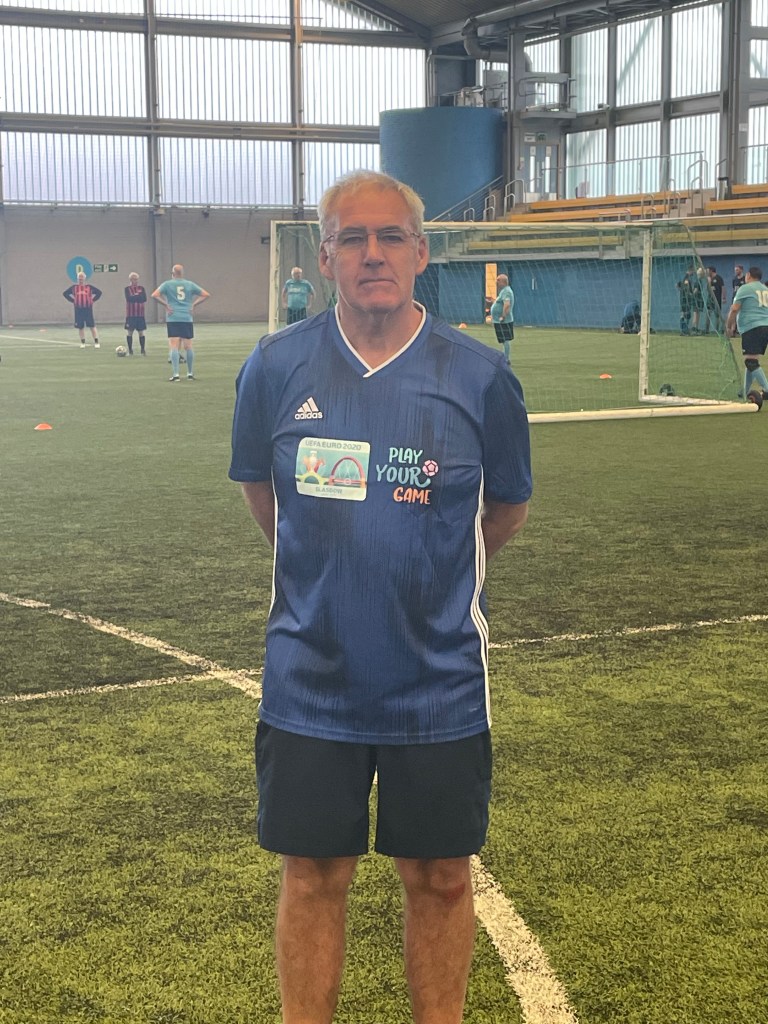
At the December Football Festival To date at least one other player from the PD pilot has also been involved in non PD weekly Walking Football sessions and I am sure more will follow.
Summary
This is a great programme that has certainly been beneficial to all involved. Not only has it improved my physical fitness, movement and balance but it has helped my mental health and confidence, and it is great to see the others involved getting similar rewards.
in common with all the other activities I am involved in the PWP are fantastic, we have great fun and have made many new friends.
Similarly the staff and volunteers who deliver this activity continually demonstrate their expert knowledge and ability, and excel in their compassion and commitment in giving their best for the group and getting the best from the group.
If you have Parkinson’s and can get to one of these sessions I would encourage you to do so. As stated earlier you do not need to have previous football experience. You will meet and work with a great crowd, get some exercise that has been specifically tailored for PWP, and have some fun. You may even be pleasantly surprised by what you are capable of achieving in these sessions. I believe other Parkinson’s Walking Football sessions are being developed around Scotland.
Brian Carson
-
Parkinson’s Table Tennis Training Camp in Altea 4th to 8th April 2022
I have spent the last week in Altea in Spain attending a Table Tennis coaching camp for People with Parkinson’s (PWP). This was the first European camp of this type that I know of and it is the intention of the organisers to make this a regular event. In this blog I have tried to describe this event in an accurate and informative way, with particular emphasis on the Parkinson’s aspects.
Note: I describe some aspects of medication adjustments I made during the week and why this was necessary. These changes were a personal decision for me and should not be read as typical, although they may be similar to what other PWP have been doing this week.
Travel
I consider myself a seasoned traveller after many years travelling while I was working and taking regular holidays abroad, notwithstanding the limitations recently due to the pandemic. However travelling alone, particularly as I have Parkinson’s introduced a level of anxiety, and self doubt I have not previously experienced.
What if I have the wrong documents, or have completed them incorrectly, or lose them? What if I press the wrong buttons at the baggage check in machine? Do I have enough medication, what if it is wearing off when I get to the passport check on arrival, will I be able to find my transfer point at Alicante Airport? Should I have asked for airport assistance when booking my flights? Will I get through the flight without any permanent scars from having to watch, listen to and suffer the impact of the many stag and hen groups surrounding me, some of who would not feel out of place in a zoo!
Thankfully everything went smoothly but these are some of the challenges I faced and now when I think back I intend to ask for assistance for future travels. This was probably a pride issue for me personally but I need to get over that and be able to ask for and accept the help available, and not just when travelling.

Destination Altea Wearing Off- what does this mean?
Motor fluctuations usually happen when levodopa (medications used to manage Parkinson’s symptoms) is wearing off, but they can happen at other times too.
In ‘wearing off’, symptoms may re-emerge when medication is due to be taken. This usually occurs near the end of a medication dose, or near the beginning of the next dose. It indicates that medication is not working as well, and needs to be reviewed.
Sometimes the effects of wearing off happen quickly – this is called ‘switching off’ or ‘on/off’.
Being ‘on’ is when a person’s symptoms are controlled and when they feel at their most capable. Being ‘off’ is when Parkinson’s symptoms come back and affect them the most.
In the early stages of Parkinson’s, you may not notice when a dose of levodopa begins to wear off. But as Parkinson’s progresses, some people find that a dose doesn’t last as long as it used to, so fluctuations can become more unpredictable.
In my case I experience wearing off for around an hour before each dose. Currently my doses are 4 hours apart. I have discussed this with my neurologist and told him I am content to “manage” these wearing off periods and that I do not want to increase my medication dose to reduce wearing off periods at this time. My reasoning is that I want to keep some “headroom” for increasing my dose of medication when my condition worsens. He is in agreement with this but we will increase my dose if my wearing off becomes unmanageable.
Altea
Cap Negret Hotel Accommodation
All the participants in the training camp stayed in the same hotel, or Athletes Village as I called it. This was ideal as we all had breakfast, lunch and dinner together and travelled mostly together back and forward to the sport centre used for the sessions. This meant we were not only playing TT together but also eating our meals together, and in some cases having drinks together immediately after retuning from a playing session or after dinner, sometimes both. This made for a relaxing atmosphere and allowed us to bond as a group and get to know each other. I have many new friends as a result and have learned so much about how others are managing this condition.
TT Venue
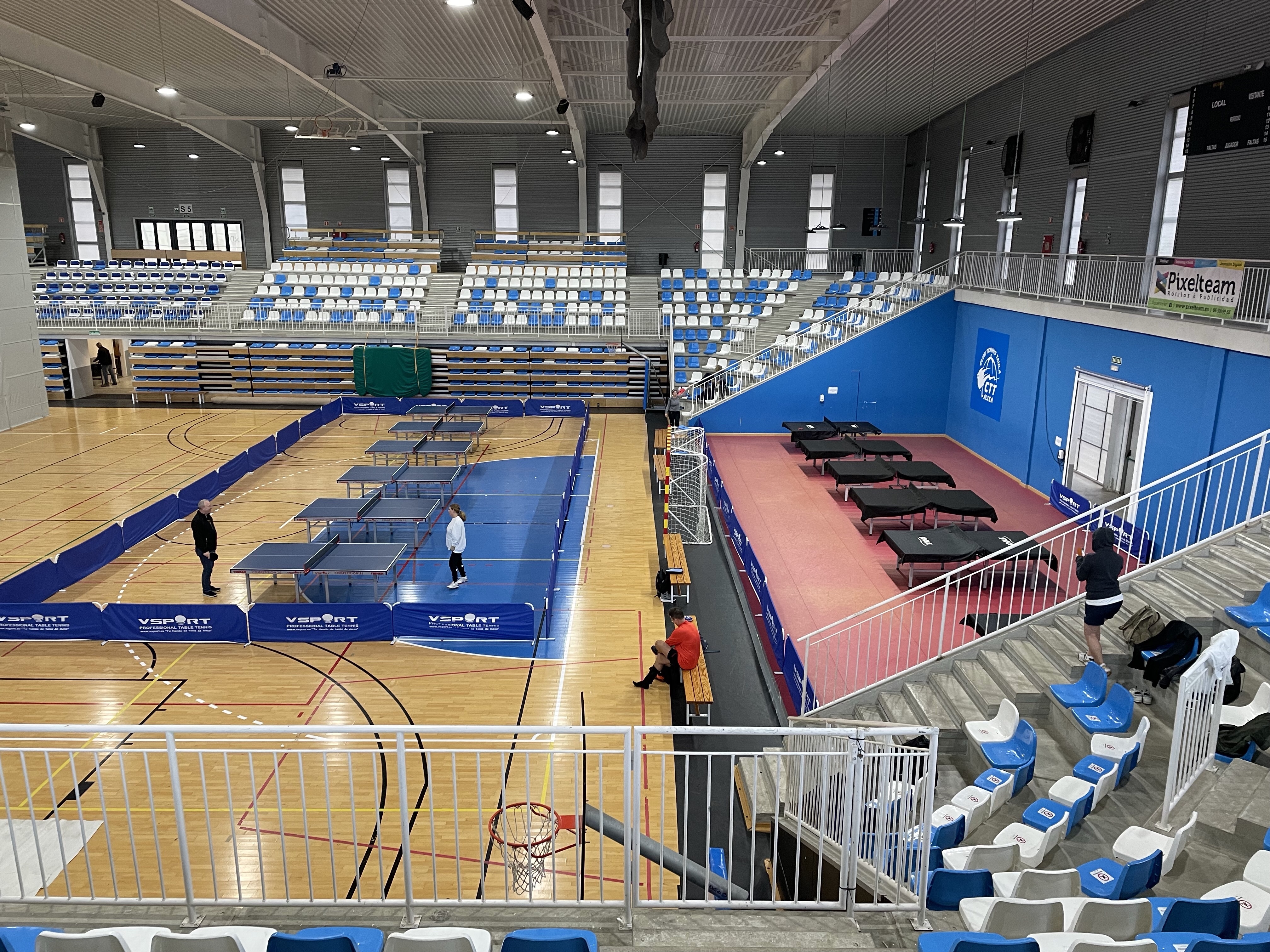
Union Deportiva Altea Sports Club The camp was based in a local sports complex the Union Deportiva Altea Sports Club. This is a massive municipal arena with seating for hundreds of spectators. Only part of the facility was needed for the TT camp and there were 12 TT tables set up for our use. The centre is located 800 metres from the hotel and most players walked back and forward each day.
The Table Tennis
Coaches
The coaches Marcus Sjolberg, Anton Åkesson and Pelle Hagelland were also in the same hotel, Sara Ramirez lives locally but did join us each day for lunch and all four were a key part in the success of this camp. Individual sessions were mostly with Marcus, Anton or Sara, and Pelle did a superb job of walking the floor making sure everyone had someone to play with, offering advice and encouragement and stepping in when one player needed to rest to ensure no one was left out.
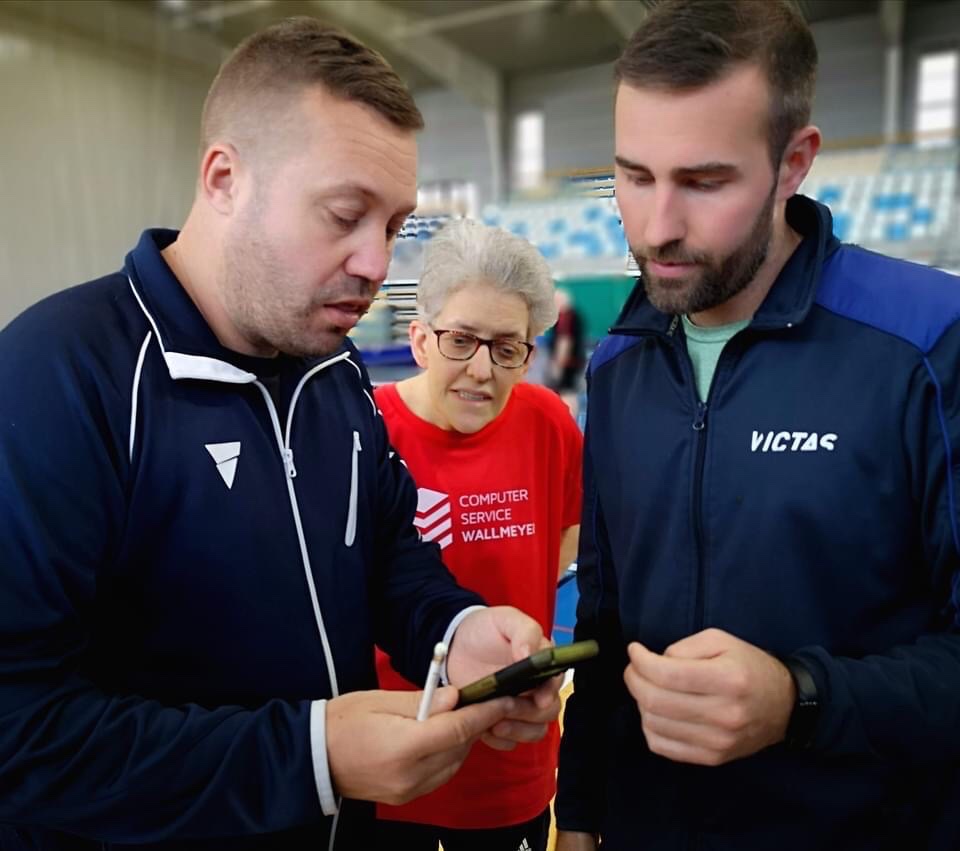
Marcus and Anton with Natascha 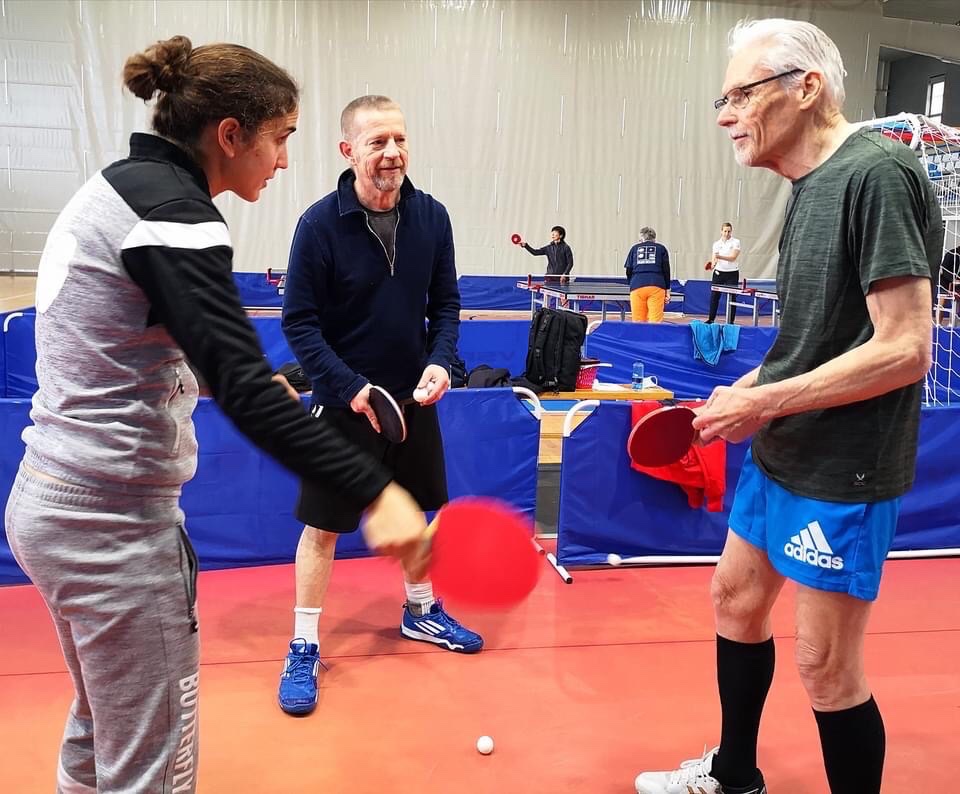
Sara with Seppo and Paul 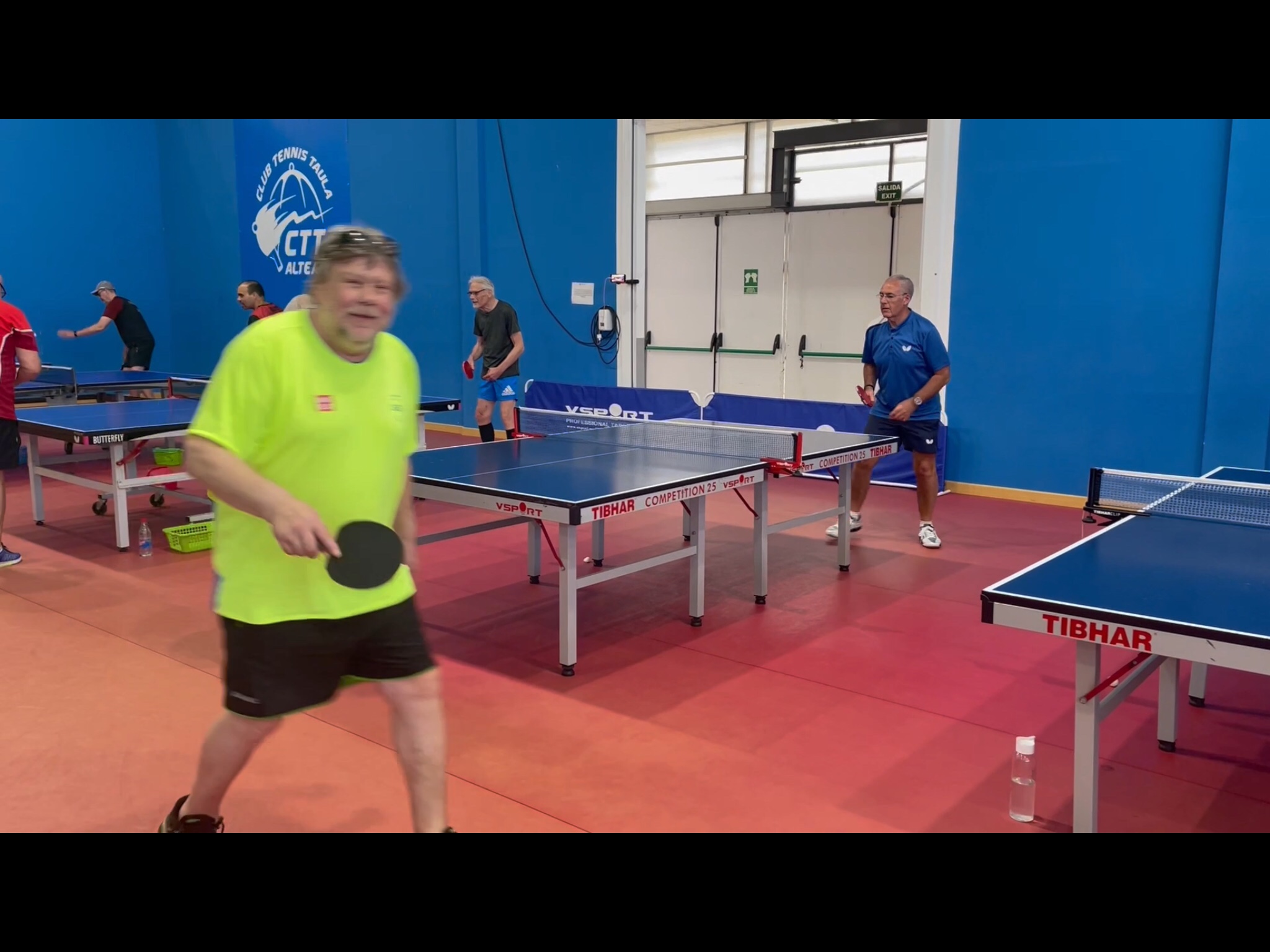
Pelle the whirlwind racing around the tables Schedule
The agreed schedule was that we would play from 10:00 to 12:00, return to the hotel for lunch and then play again from 14:00 to 16:00 each day. On day 2 because of the enthusiasm of the participants we started turning up at 09:15 and in some cases playing until 17:00. Therefore on some days we were playing for six hours.
Throughout the week every player had numerous one to one sessions with coaches where got the opportunity to work on specific aspects of their game. At the start of these sessions the player was asked to state what particular aspect of their game they would like to work on and this was then “coached” to help them improve, mainly using the multi ball technique (non TT players may need to google this).
During my sessions I worked on forehand top spin when receiving top spin and back spin balls, backhand, blocking, serving, receiving serve to name but a few. We also played many games with opponents of similar abilities where we got the opportunity to use what we had learned in the coaching sessions. The objective was not to win the games but to practice what we had learned in a match scenario.
Repetition is often used in TT coaching as a way of refining particular shots and improving consistency. As you can imagine this was a great opportunity to use this method having so much table time over 5 days with a variety of practice partners. Repetition is also used in other Parkinson’s focussed exercise types as a method of assisting with Neuroplasticity . Neuroplasticity refers to the brain’s ability to reorganise itself both in its structure and how it functions. The brain continuously creates new cells (neurogenesis). New findings suggest that intensive, challenging, repetitive and cognitively demanding exercises could induce neuroplasticity in PD. TT fits into this group of exercises.
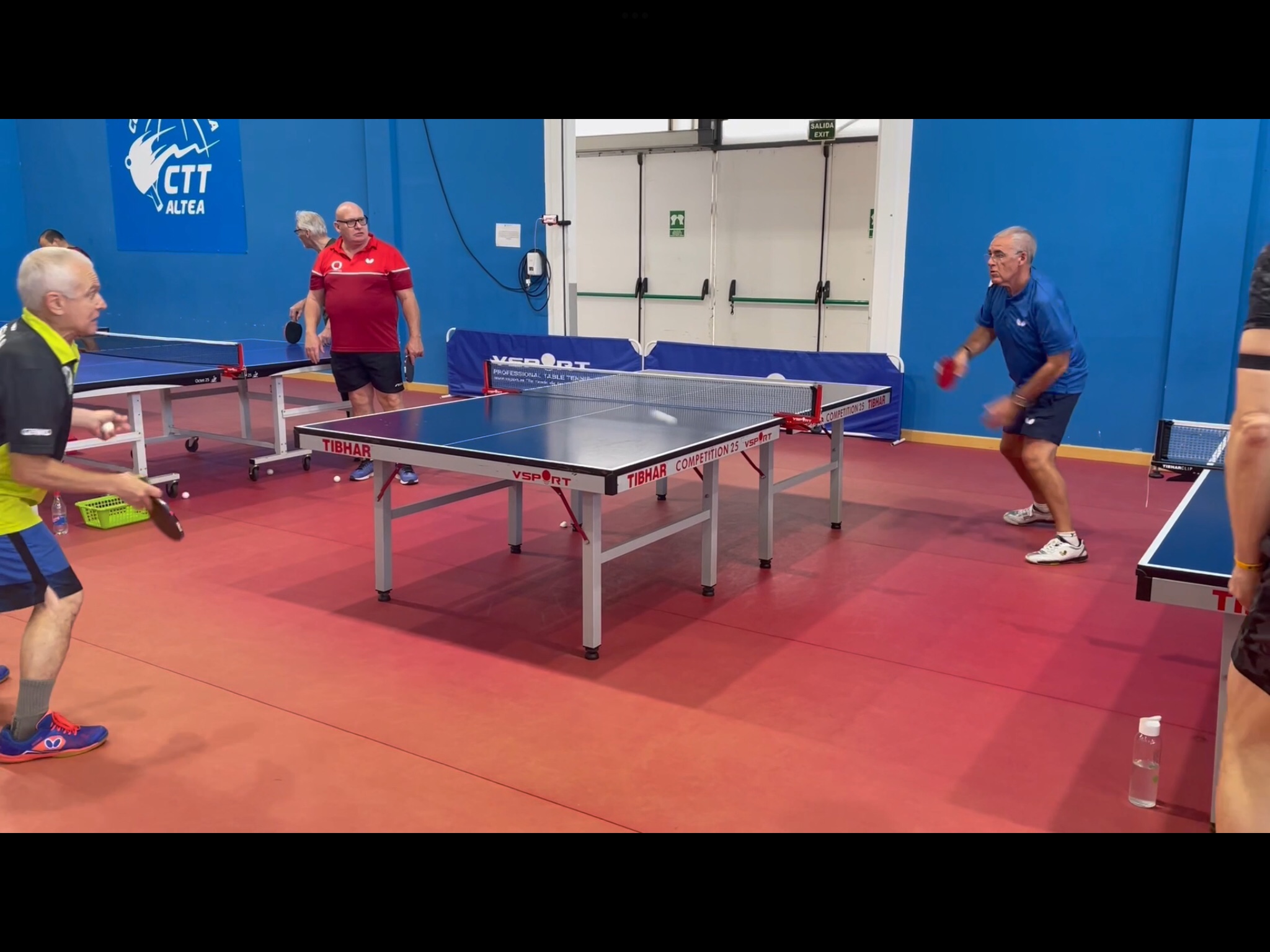
Jesper watching Ronnie and Brian On Thursday we had an afternoon off to relax and explore Altea. As I had explored in my two days of “acclimatising” before the camp started I decided to relax by the pool in the sunshine, where I was joined at various times by different members of the group. This break was well received as an opportunity to relax and rest weary our bodies.
Hotel Pool Participants
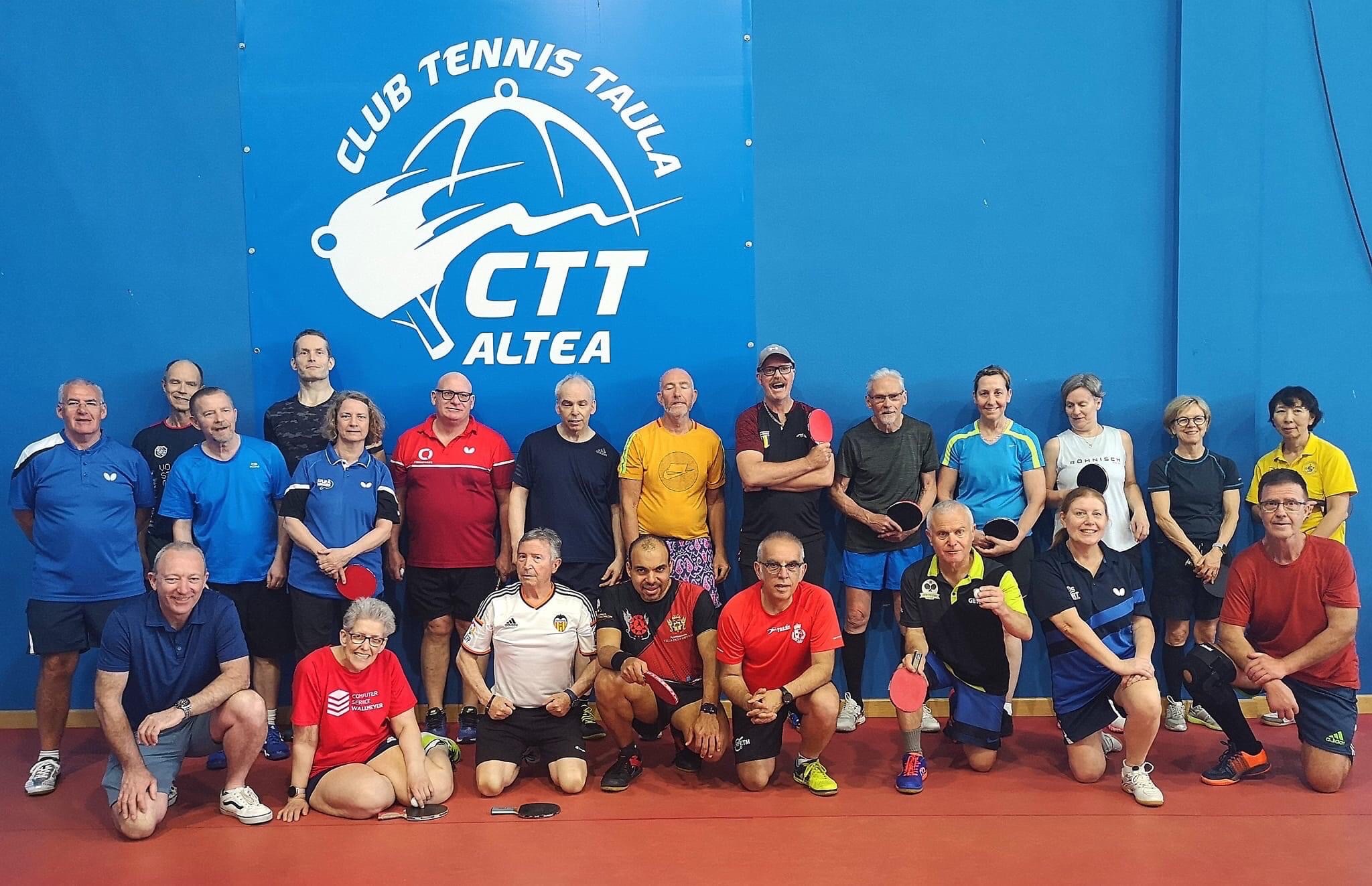
The Dream Team Although there were many levels of TT ability across the group I think I played with every single player at some point during the week, some more than others and during these sessions if there was a “stronger” player then they would tend to provide advice to their opponent. Special thanks from me to Jesper Jerslund who spent to time helping me to read spin from opponents serve, and almost managed to hide his frustration well when I got it wrong. 😂
Dealing with our condition
As you can imagine playing sport for six hours a day for a week would be a challenge for most, but factor in that everyone playing has Parkinson’s then a whole new set of issues become part of the equation. Players got fatigued and had some minor aches and pains, more so as we progressed through the week. The biggest challenge though, certainly for me was managing my medication and fatigue to get the maximum benefit from the week. I needed to be flexible in both the timing of taking my medication and in some cases in the dose taken.
The timing adjustments were made to ensure I minimised my off times to prevent these from excluding me from sessions, or from reducing my flexibility and coordination while playing. Level of dose is a different issue. While exercise is recognised as part of the Parkinson’s treatment regime to help movement and is quoted in some areas as helping to slow progression of the disease, this is more of a long term strategy. In the very short term, certainly in my case and in those of others I have discussed this with, vigorous exercise can accelerate wearing off and cause severity of symptoms to increase. This is very short term, mainly in the period when the exercise is being undertaken and immediately after, and to combat this my doseage levels were adjusted upwards at certain times each day. On completion of the camp I have reverted to my previously agreed dose.
Relaxing after a long day Summary
This has been a great experience that I would not hesitate to repeat. It has been challenging at times but everyone involved accepted this head on. A week in the Spanish sunshine (well mostly sunshine), playing TT with a group of people who have a degenerative disease but refuse to let it define them and who have found an activity they love. What’s not to like about that. I have made many new friends, got to know some who were already friends better (Joy and Stephen) and will see most if not all of them again as we continue our Parkinson’s TT activities in Germany, Portugal, Croatia and the UK this year.
Has my game improved as a result of this week’s activities? I hope so, but time will tell as I get back to playing in my regular clubs in Scotland when I get home.
However, the answer to that question is not what is important. What is important is the experience I have had this week, what I have learned and shared, the friends I have made and this fantastic Table Tennis movement we are all a part of.
Brian Carson
-
Table Tennis and Parkinson’s, a Blog by Brian Carson
1 April 2022
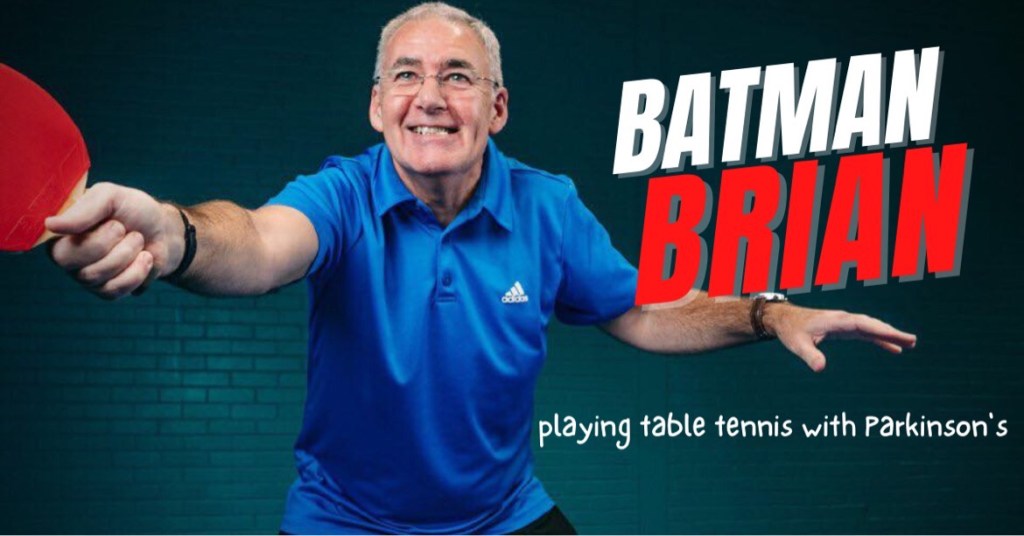
Many of you will know I started playing Table Tennis last year and quickly caught the “bug” enjoying the game not only for the fun and challenge it gives but also because it helps me manage some of the symptoms of my Parkinson’s Disease.
I have got to a point where TT is a key feature of my weekly exercise regime along with Walking Football, Pilates, PD Warrior Classes, Cycling, Badminton, and more recently short tennis (Bennis!). Shout out to Jon Clement who keeps adding sports to my portfolio 👍.
This is the first in what I hope will be a series of blogs about Parkinson’s Disease and how regular activity is a major part of the treatment regime for this disease. These blogs will mostly concentrate on table tennis as I have a few travels and events planned for this year all involving TT and most, if not all of these events are specifically for People with Parkinson’s (PWP). Other activities will be included as things develop.
I hope to spread the message of how PWP cope and manage with this condition in general but also highlight how participation in regular activity/ exercise helps not only with the physical aspects of the disease but also supports positive mental health. Depression, anxiety, and apathy are just a few of the non motor symptoms PWP may have to deal with.
The intention is not to preach or seek sympathy but to inform and share experiences (possibly to entertain but no promises) and maybe even encourage more PWP to take part in activities, or exercise, or increase their levels if they are already active.
Apologies in advance if you are not interested, however reading these is not compulsory. If you like them let me know, if you don’t like them keep it to yourself 😵💫.
Today, 1st April 2022 (this is not an April fool prank) I arrived in Altea in Spain to participate in a “top-class Table Tennis Camp”. This is a TT coaching camp specifically for players who have Parkinson’s’s Disease. The camp will be run over 5 days from Monday 4th April with morning and afternoon sessions each day. The coaches for this camp are:
Marcus Sjoberg ( former National coach for men in Sweden and England).
Anton Åkesson (previously head coach for some of the top clubs in Sweden).
Pelle Hagglund (currently coaching players with Parkinson’s Disease in Sweden).
During the camp players from the top league in Spain will be having a game for us to watch and learn.
There will be 21 players with Parkinson’s at the camp from various countries, Sweden, Spain, Denmark, The Netherlands, Norway, Israel, and not forgetting Scotland.
As you can imagine I can’t wait to get started and play and learn from these European coaches and players, building on what the fantastic coaches in Scotland have done to develop my game. The end game for me is not only to have a great experience, improve my game, meet new players and have fun, but also to give me some tools and skills that I can use to help other players with Parkinson’s that I play with weekly at Parkinson’s sessions at Drumchapel and Mossblown. Note: this is not about making me a coach, that comes later in the year through other opportunities that will become clear nearer the time.
I now have a couple of days to relax and enjoy the sunshine before we get started. I will publish short updates regularly throughout the week on Facebook and issue a new blog about the whole experience when I get home to Scotland.
Brian Carson
Thanks to Robyn Carson for helping with the title (Batman Brian, well I like it!) and Leona Braund for creating the graphic.
-
Subscribe
Subscribed
Already have a WordPress.com account? Log in now.
 Batman Brian